


find your
Perfect
Product
Why do the dark spots on your shoulders and legs persist long after your facial complexion has cleared? The skin on your body is a thicker, more resilient barrier that requires a specialized clinical strategy to transform. If you have spent months applying "natural" remedies only to see zero change, you aren't alone. You deserve to know exactly how to get rid of dark spots on the body using a resurface-first philosophy that actually penetrates the epidermal layer. Whether you are dealing with persistent bacne scars or friction-induced darkening in sensitive areas, the path to a uniform tone requires more than just hope.
We understand the frustration of hiding under layers or feeling self-conscious in backless clothing because of marks that refuse to fade. It's time to stop settling for ineffective treatments and start a regimen that respects the biology of your skin. This professional guide provides the clinical approach you need to achieve a flawless, uniform skin tone from head to toe. You will discover the science of hydroquinone-free brightening, the specific ingredients that target melanin at the source, and a simple but powerful daily routine designed for high-stakes transformation. We are moving past the guesswork and into a curated journey toward lasting confidence.
Have you noticed that the marks on your legs or back seem to linger indefinitely, even when your facial complexion remains clear? This isn't a coincidence. Hyperpigmentation on the body is the overproduction of melanin triggered by inflammation or physical injury. While it manifests as stubborn discoloration, it serves a specific purpose. Hyperpigmentation is the skin’s biological defense mechanism that over-corrects after trauma. To master how to get rid of dark spots on the body, you must first identify the specific triggers that keep your skin in a state of constant repair.
We categorize the primary culprits as the "Body Three":
Understanding how to get rid of dark spots on the body starts with recognizing that these spots are often deeper and more resilient than those on your face. Because the skin below the neck is structurally different, your approach must be equally specialized.
Why do certain areas of the body seem prone to darkening regardless of your skincare routine? Areas like the underarms and inner thighs are subject to constant skin-on-skin contact. This friction triggers melanocyte activity, the cells responsible for pigment. When you add tight clothing or the abrasive nature of shaving into the mix, you create chronic, low-grade inflammation. It's a common misconception that this darkening is related to hygiene. In reality, it's a physiological response to mechanical stress. Your skin thickens and darkens to protect itself from the perceived "attack" of constant rubbing.
The skin on your back, arms, and legs is significantly different from the delicate skin on your face. Both the dermis and the epidermis are much thicker on the body. This structural density creates a massive penetration challenge for standard skincare. Many people find that facial serums show no results on the body because the active ingredients simply cannot reach the deep pigment-producing layers. To see a visible change, you need higher concentrations of active resurfacing agents. You aren't just treating a surface stain; you are attempting to communicate with cells buried beneath a much tougher barrier. This is why a "resurface-first" philosophy is vital for body clarity.
How exactly do you dismantle a dark spot? To understand how to get rid of dark spots on the body, we must look at the cellular level. Most discoloration begins with an enzyme called tyrosinase. This enzyme acts as a catalyst for melanin production. By introducing tyrosinase inhibitors, we can effectively signal the skin to stop overproducing pigment at the source. It is the same reason dermatologists recommend specific active ingredients that target this biological pathway to ensure the skin returns to its natural state.
Stopping production is only half the battle. The pigmented cells that already exist must be moved to the surface and removed. This process, known as sloughing, is vital because body skin renews itself much slower than facial skin. While your face might cycle through new cells every few weeks, your body can take 28 to 40 days or longer. Consistency in your daily routine isn't just a suggestion; it's a physiological requirement to see a total transformation. Clarifying agents work by breaking up these existing pigment clusters, allowing them to be shed more efficiently.
Specific formulations, like a high-performance clarifying gel for dark spots, work by interfering with the chemical signals that lead to darkening. Many people make the mistake of only "spot treating" a visible mark. This is less effective than treating the entire surrounding area. By applying a clarifying agent to the whole region, you manage the "pigment field." This ensures that the surrounding skin remains uniform as the dark spot fades, creating the seamless, professional finish that high-end consultations strive for. It is a proactive way to manage how to get rid of dark spots on the body before they become permanent fixtures.
Physical scrubs often provide a temporary feeling of smoothness, but they rarely reach deep-seated discoloration. Chemical resurfacing is the superior choice for body skin. It works by ungluing the "cellular cement" that holds dead, pigmented cells to the surface. When you use acids designed for the body's thicker barrier, you accelerate the renewal process. This allows you to achieve professional-grade results at home without the trauma of aggressive physical exfoliation. If you want to see a visible shift in your tone, you must prioritize chemical resurfacing to clear the way for your clarifying treatments to work. Building a regimen around these two pillars is the most direct path to restoring your skin's natural health.
When researching how to get rid of dark spots on the body, many people assume that the most expensive option is the most effective. It's a common trap. While in-office treatments promise rapid change, they often come with hidden costs and physiological risks that aren't always discussed in the consultation room. Choosing the right path requires an understanding of how your skin handles trauma and what it takes to maintain clarity over time.
Lasers and deep chemical peels work by inducing controlled trauma to the skin. The theory is simple: destroy the pigmented tissue to force the body to grow new, clear skin. However, for those prone to post-inflammatory hyperpigmentation (PIH), this "wounding" can backfire. It often triggers a defense response known as rebound hyperpigmentation, where the skin produces even more melanin to protect the injured area. Age spot treatments performed in a clinic usually require multiple sessions. Prices for these procedures frequently range from $500 to $2,000 per visit, depending on the size of the treatment area. Beyond the financial investment, the downtime is significant. You are often left with redness, peeling, and a strict requirement to avoid all sun exposure, which can be difficult when treating large areas of the body.
If you want a more sustainable and less invasive path, professional-grade topical systems offer a compelling alternative. When we say "professional-grade," we aren't talking about weak drugstore lotions. We mean products formulated with clinical concentrations of active ingredients designed for safe, daily home use. Using a resurfacing creme for clear skin allows you to achieve consistent, daily correction without the trauma of a laser. This methodical approach respects the body's natural renewal cycle while delivering high-stakes results.
Why is daily maintenance superior to periodic aggression?
Achieving a flawless tone is a marathon, not a sprint. By choosing a regimen that works with your skin's natural rhythm, you ensure that once you learn how to get rid of dark spots on the body, you have the tools to keep them away for good. It's about empowering yourself with a routine that offers both safety and clinical authority.
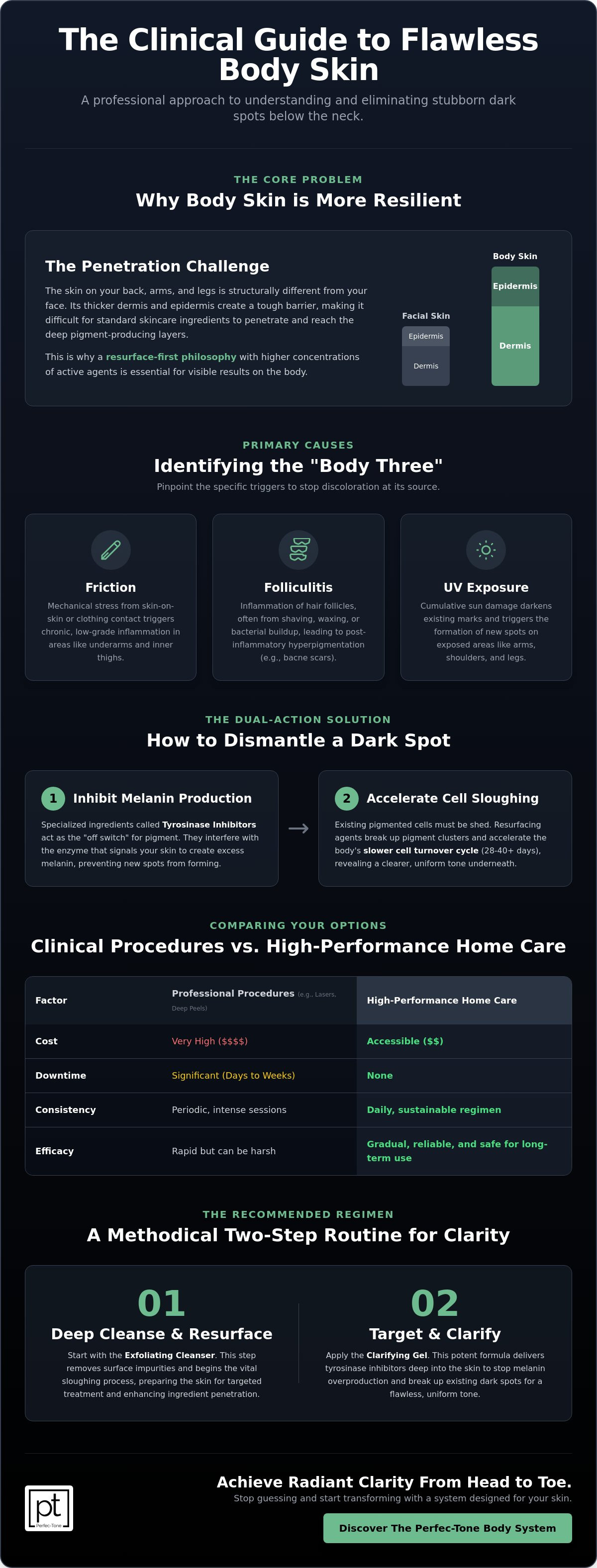
Are you ready to move from theory to results? To truly understand how to get rid of dark spots on the body, you must adopt a regimen that mimics a professional clinical cycle. This isn't about a single "miracle" product; it's about a coordinated sequence that prepares, treats, and protects your skin. When you follow a methodical system, you stop guessing and start transforming. Maintaining this disciplined routine for 8 to 12 weeks is the biological requirement for visible change, as it allows your skin to complete multiple renewal cycles while inhibiting new pigment.
Is your current body wash actually preparing your skin for transformation? A standard body wash is designed to remove surface grime; it isn't formulated to dismantle the cellular cement holding onto pigment. To prime your skin barrier, you need a clinical start. Using an exfoliating cleanser for dark marks does more than just clean. It utilizes active agents to sweep away the dense layer of dead cells that often block treatment penetration on the back and limbs. During this step, you should feel a thorough, refreshing sensation. This "clinical tingle" is the sign that your pores are clear and your skin is ready to receive the corrective ingredients that follow.
Once the skin is primed, you move into the active correction phase. Apply your Clarifying Gel to the entire affected region, not just the individual spots. This "field treatment" ensures that you are inhibiting melanin production across the whole area, preventing new spots from emerging while the old ones fade. For those seeking maximum impact, layering a refining creme for uneven skin tone creates a synergistic effect. This combination boosts the brightening process and helps smooth the skin's texture simultaneously. If you notice slight sensitivity, don't panic. Simply "rest" the skin for a day by skipping the active steps and focusing on hydration before resuming your regimen.
The final pillar of your routine involves deep resurfacing and protection. Following your corrective treatments with a Resurfacing Crème accelerates the removal of damaged, pigmented cells. This step is what creates that sought-after "sloughing" effect, moving clear, healthy skin to the surface faster than your body would on its own. Finally, never neglect moisture and sun protection. Even on the body, UV rays can undo weeks of progress in a single afternoon. Seal in your results with a high-quality moisturizer to maintain the health of your newly revealed skin. It's time to take control of your skin's future. Explore our professional body systems to find the exact combination your skin has been waiting for.
For over 40 years, we have refined a legacy of specialized expertise to serve those whose skin needs have been historically overlooked. Our philosophy isn't built on airy promises. It's rooted in a results-oriented, clinical approach that empowers you to achieve the transformation you've long awaited. We understand that your journey toward a uniform skin tone is personal. It is about more than just aesthetics; it is about the confidence to wear what you love and feel comfortable in your own skin. When you commit to learning how to get rid of dark spots on the body, you deserve a system that delivers professional-grade clarity without the need for aggressive clinical wounding.
Why do standard treatments often fall short on the body? The answer lies in the barrier. The skin on your limbs and torso is significantly thicker than facial skin, requiring a strategic entry point. Our Exfoliating Cleanser serves as this vital gateway. It doesn't just wash the surface. It actively prepares the skin by sweeping away the cellular debris that would otherwise block your progress. This ensures that our Clarifying Gel, the primary weapon against deep-seated pigment, can reach the target layers effectively. This duo works in tandem to inhibit melanin production at the source while breaking up existing clusters. You don't have to settle for "natural" remedies that show no results. You can take control of your skin transformation today with a duo designed for high-stakes change.
The final step in achieving a flawless, uniform tone involves addressing the "tough" spots. Areas like the knees, elbows, and back are prone to a thickening of the skin that traps pigment deep within the dermis. Our Resurfacing Crème acts as the clinical finisher for your regimen. It provides the intensive cellular turnover necessary to reveal a radiant, even glow. By accelerating the sloughing process, this crème helps you transition from dull, marked skin to a complexion that is uniform from head to toe. It's time to experience the difference that 40 years of pioneering spirit can make. Transform your body skin with the Perfec-Tone collection and reclaim your confidence with a simple but powerful daily routine.
Achieving a flawless, uniform tone is no longer a matter of guesswork. You now understand that the secret to how to get rid of dark spots on the body lies in a resurface-first philosophy that respects the skin's thicker barrier. By prioritizing chemical exfoliation and consistent melanin inhibition, you bypass the risks of aggressive lasers while achieving clinical-grade results. Remember that your skin requires an 8 to 12 week commitment to fully reveal its new, clear layers.
With 40+ years of skincare expertise, our systems are clinically formulated for deep pigment correction. You don't have to endure the high costs or downtime of in-office procedures to see a life-changing transformation. It's time to stop hiding and start healing. Shop the Perfec-Tone Clarifying Collection for Professional Results at Home and begin your journey toward lasting clarity today. Your most confident self is waiting to be revealed.
Visible changes typically occur within 8 to 12 weeks of consistent daily use. This timeframe is dictated by the body's natural renewal cycle, which is significantly slower than facial skin. You must allow enough time for several layers of pigmented cells to slough away and be replaced by clear, healthy tissue. Consistency is the primary factor in achieving a professional finish.
You can, but they are often less effective because body skin is significantly thicker and tougher than facial skin. Most facial serums lack the concentration of active resurfacing agents needed to penetrate the dense epidermal barrier on your back and limbs. For real results on how to get rid of dark spots on the body, you need professional-grade formulations designed for body resilience.
Yes, these treatments are highly effective for post-inflammatory hyperpigmentation (PIH) caused by scars and bites. These marks are essentially clusters of excess melanin left behind after the skin heals from trauma. By using targeted clarifying agents and resurfacing crèmes, you can dismantle these clusters and return the area to a uniform, flawless tone across the entire body.
It is safe, but you should proceed with a methodical approach to prevent irritation. Start by applying the product every other day to assess your skin's tolerance in these friction-prone areas. If you experience redness, simply "rest" the skin for 24 to 48 hours and focus on hydration before resuming your corrective regimen to ensure the best transformation.
Brightening creams often focus on surface-level radiance and hydration, while a clarifying gel is a deeper, more clinical solution. Clarifying gels are formulated to inhibit the tyrosinase enzyme, stopping the overproduction of melanin at its biological source. This makes them the primary weapon for dismantling deep-seated discoloration rather than just improving temporary surface glow or texture.
We recommend consulting your healthcare provider before introducing new active skincare during pregnancy or breastfeeding. While many topical ingredients are safe, your body's sensitivity and hormonal balance shift during this time. A professional medical consultation ensures the safety of both you and your baby while you manage your specific skin needs and work toward a clearer complexion.
This is a normal part of the sloughing process where pigmented cells are pulled to the surface. As your resurfacing treatment unglues the cellular cement, the deep pigment moves upward toward the top layer of the epidermis. This temporary darkening is a diagnostic sign that the treatment is successfully accelerating your skin's renewal cycle and clearing the path for clarity.
Featured Product

Why You'll Love It You want your dark marks gone, but your skin does not tolerate harsh treatments. The s...
Clear skin and even skin tone, not adapted from generic formulas — built specifically for dark spots, hyperpigmentation, and acne.
