


find your
Perfect
Product
Why does your skin treat a temporary blemish like a permanent scar? If you've ever watched a breakout fade only to be replaced by a stubborn, dark shadow, you know the frustration of "ghosting" on your own face. Many over-the-counter serums simply don't penetrate deep enough to make a difference; meanwhile, the reality that the FDA has not approved OTC hydroquinone or mercury-based lighteners makes finding a safe solution feel daunting. Finding an effective targeted spot treatment for discoloration shouldn't feel like a gamble with your biological health.
We understand that you're looking for more than just a vague glow; you want visible precision. It's time to stop settling for generic products that treat your whole face while ignoring the specific spots that actually bother you. You can achieve a uniform, radiant complexion using the right clinical approach. This guide reveals how to eliminate those lingering marks and restore an even skin tone using high-performance, non-prescription methods. We will walk you through a professional-grade routine you can master at home to finally secure the lasting clarity you deserve.
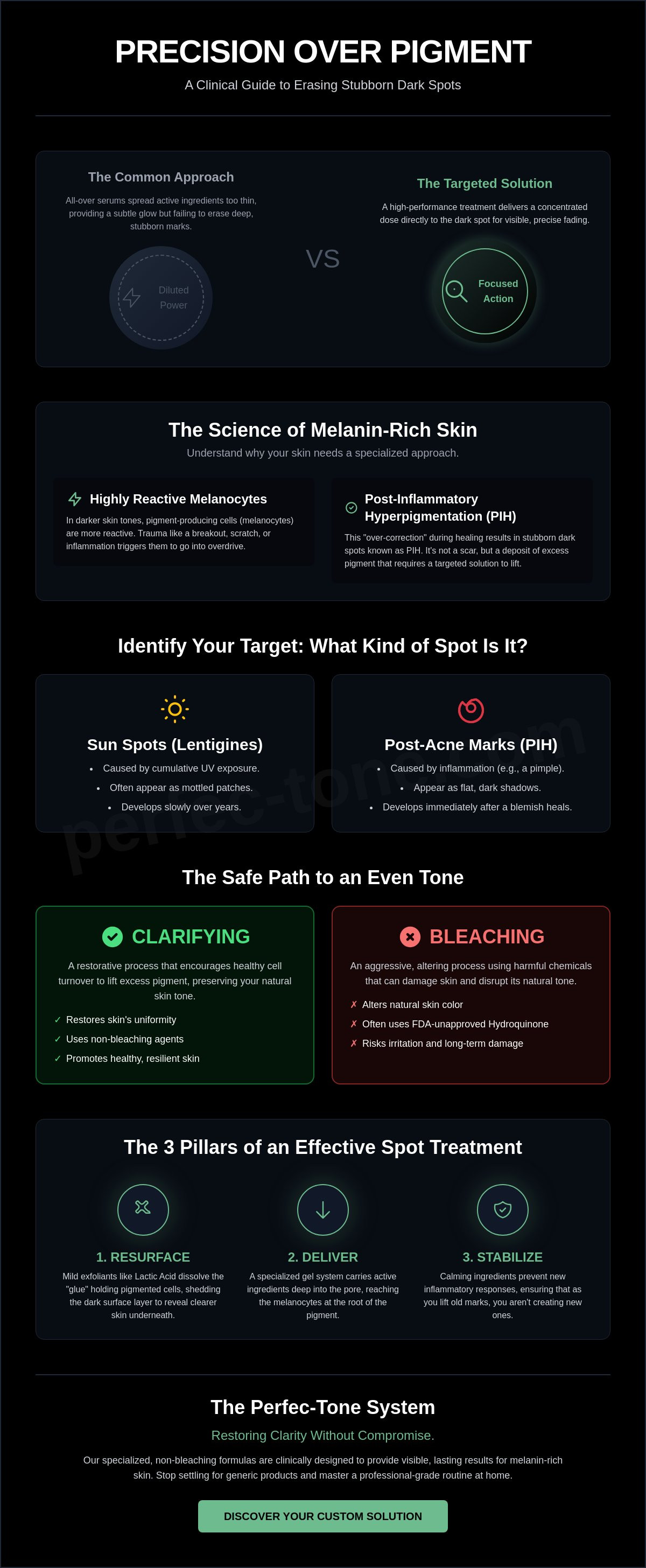
Have you ever wondered why that one dark mark remains long after the rest of your complexion has cleared? A general brightening serum might provide a subtle glow, but it often lacks the potency required to dismantle deep-seated pigment. A targeted spot treatment for discoloration is a high-concentration topical designed for surgical precision. It delivers active ingredients directly to the site of the concern without affecting the surrounding, healthy skin. For those with melanin-rich skin, this distinction is vital. You aren't just looking for a "brightening" effect; you're looking for a solution that addresses the specific biology of your skin.
Hyperpigmentation behaves differently depending on your biological makeup. In darker skin tones, the melanocytes are highly reactive. When the skin experiences trauma, like a breakout or a scratch, these cells go into overdrive. This results in Post-Inflammatory Hyperpigmentation (PIH). While all-over serums are excellent for daily maintenance, they often fail to lift these specific, stubborn shadows because the active ingredients are spread too thin. You need a concentrated formula that penetrates deep into the pore to address the root of the pigment. This is where a targeted spot treatment for discoloration becomes your most powerful tool.
Identify the source to determine the solution. Sun-induced lentigines, or sun spots, are the result of cumulative UV exposure over years. Post-acne marks are different; they are inflammatory shadows that appear almost immediately after a blemish heals. Melanin-rich skin is genetically programmed to protect itself, which often leads to "over-correcting" during the healing process. If your mark is flat and appeared after a pimple, it's likely PIH. If it’s a mottled patch from years of sun, the treatment approach requires even more persistence and a focus on cellular turnover.
Many people avoid treatment due to a valid fear of bleaching agents. Let's be clear: clarifying is not bleaching. Bleaching involves aggressive, often harmful chemicals like hydroquinone, which the FDA has strictly regulated since 2026 due to safety concerns. We focus on clarifying, a restorative process that encourages healthy cell turnover. By using non-bleaching agents, a professional spot treatment preserves your natural, beautiful skin tone while only removing the excess pigment. It’s about restoration, not alteration. This approach ensures your skin remains healthy, resilient, and uniform.
What makes a formula truly effective against deep-seated pigment? It isn't just about a single "hero" ingredient. It's about a sophisticated architectural design. A high-performance targeted spot treatment for discoloration must do more than just lighten; it must physically transform the skin's surface while chemically inhibiting future damage. While many brands chase the latest "trendy" botanical extract, professional-grade results rely on a curated list of biologically active compounds that have stood the test of clinical scrutiny. We don't chase the "ingredient of the month"; we rely on a selection of time-tested actives that deliver predictable, life-changing outcomes.
First, the formula must address the surface. Pigment often sits in the upper layers of the stratum corneum. Without a resurfacing agent to clear these "inked" cells, even the best brightening ingredients will struggle to reach their destination. Second, the treatment requires a delivery system that carries active molecules deep into the pore where melanocytes reside. This is why specialized gels are often preferred over heavy oils for localized issues. Finally, the inclusion of stabilizing ingredients is non-negotiable. These components ensure that as you lift old marks, you aren't triggering new inflammatory responses that lead to more shadows.
How do you remove a mark that feels permanent? The answer lies in "unsticking" the surface. Mild exfoliants like lactic acid work by dissolving the cellular glue that keeps pigmented cells trapped on the skin. As these dark cells shed, the skin enters a "refining" phase. This isn't just about color; it's about smoothing the actual texture of the skin. A well-formulated Resurfacing Crème accelerates the natural cell turnover cycle to reveal fresh, vibrant tissue faster than your body could on its own. This dual-action approach ensures the skin looks polished, not just lighter.
Why can't you just use a brightening moisturizer? The difference is the "payload." A daily moisturizer is designed for hydration and barrier protection, meaning its active brightening agents are often diluted to prevent irritation over large areas. In contrast, a targeted spot treatment for discoloration contains a significantly higher percentage of clarifying actives. It's a concentrated strike rather than a general mist.
The "delivery vehicle" also changes the outcome. While a standard crème sits on the surface to lock in water, a specialized gel is designed for rapid, deep penetration. This allows the formula to bypass the skin's natural defenses and reach the specific cluster of melanin it's designed to treat. However, remember that precision is the goal. More isn't always better; applying a high-potency treatment to healthy skin can cause unnecessary dryness. You want a surgical application, not a saturated one.
Are you dealing with a single, persistent shadow from last month's breakout, or is your entire complexion feeling dull and uneven? Identifying the scale of your concern is the first step toward a successful transformation. A targeted spot treatment for discoloration is your scalpel. It’s designed for high-impact intervention on isolated marks that refuse to budge. Conversely, if you struggle with widespread texture issues or excessive oiliness alongside pigment, an all-over solution is the logical choice. You don't want to use a high-potency spot treatment on your entire face, just as you wouldn't use a general moisturizer to fix a specific scar.
For those managing broader concerns, a Clarifying Gel for Dark Spots serves as the foundational layer for uniform restoration. It addresses the entire facial landscape, balancing oil production while gently lifting surface pigment. If your goal is a total skin reset, the gel provides the "canvas" while the spot treatment handles the "details." Understanding this distinction prevents product waste and ensures your skin receives exactly what it needs without being overwhelmed by excessive active ingredients.
How do you know when to switch from a localized approach to a full-face regimen? Use the "Three-Mark Rule." If you can count three or fewer distinct, stubborn marks, continue with your targeted spot treatment for discoloration. If the discoloration is diffuse, mottled, or covers more than 30% of your face, your melanocytes are likely in a state of general overactivity. In this scenario, a full-face clarifying product is more efficient. Many of our clients find success using both in tandem: apply the Clarifying Gel to the whole face first, then layer the Spot Treatment specifically on the darkest "anchor" marks for double the efficacy.
Patience is a professional virtue. Skin cells typically take 28 to 40 days to cycle from the deep layers to the surface. Expecting a mark to vanish overnight ignores the basic biological reality of your skin. Most users see the first signs of visible fading within 4 to 8 weeks of consistent use. During the first month, look for "softening" of the edges of the spot rather than total disappearance. Melanin-rich skin requires a steady, rhythmic approach. Intensity often leads to irritation, which triggers more pigment. Consistency always wins the long-term game of clarity.
Is your current routine working as hard as you are? It won't if you're layering your products incorrectly. Buying a professional formula is only half the battle; to see a real transformation, you must master the art of application. A targeted spot treatment for discoloration isn't a "slather and go" product. It requires a methodical, step-by-step approach to ensure the high-concentration actives remain where they belong: directly on the mark. Follow this professional protocol to maximize your results.
Ready to start your transformation? Secure our professional Spot Treatment to target your most stubborn marks today.
Why do we emphasize the evening? Your skin enters a natural repair phase while you sleep, making it the ideal time for intensive correction. Integrating your targeted spot treatment for discoloration into a comprehensive skincare routine for acne and dark spots at night maximizes the biological window for healing. Don't mix too many different acids at once; let your spot treatment be the star of the show to avoid overwhelming your skin's barrier.
Are you over-spotting? More isn't better. Applying too much product or using it too frequently can cause localized irritation, which ironically triggers more melanin production. Also, don't let the "darker before lighter" myth discourage you. As pigmented cells rise to the surface to be shed, the mark may temporarily appear more defined. This is a sign that the treatment is working. Stay the course and, most importantly, don't pick at the skin. Picking resets the inflammatory clock and creates new shadows.
Consistency is the hallmark of professional skincare. While a targeted spot treatment for discoloration is the cornerstone of your localized fading efforts, it achieves its peak potential within a structured system. At Perfec-Tone, we don't believe in isolated fixes. Our approach is holistic, ensuring that as you target specific marks, the rest of your skin is nourished and refined. By pairing our Spot Treatment with the Resurfacing Crème and Refining Crème, you create a synergistic environment where pigment is lifted, texture is smoothed, and the skin's barrier remains resilient. You don't need a prescription to see professional results; you just need a system designed for your specific biological needs.
How do these products work together? Think of the Spot Treatment as your precision strike, while the Resurfacing Crème acts as the support crew that clears the way by accelerating cellular turnover. The Refining Crème then steps in to polish the final result, ensuring that the new skin appearing at the surface is as healthy and vibrant as possible. This methodical progression is what separates a professional routine from a basic one. We've spent decades perfecting this rhythm so you don't have to guess. Our goal is to provide you with the tools to manage your skin with the confidence of a professional consultant.
Does your skincare brand truly understand the history of your skin? Perfec-Tone was born in 1980, rooted in the vibrant community of the Bahamas. Our founder, Lila Pinder, started with a mission to serve skin that the broader industry had historically ignored or underserved. Over the last four decades, our formulas have evolved from local secrets to global standards, shaped by direct feedback from thousands of melanin-rich clients. This longevity provides a level of reliability that "trendy" newcomers cannot match. We operate as a wise mentor for your skin, prioritizing long-term health and cellular integrity over aggressive, temporary quick fixes. When you use our targeted spot treatment for discoloration, you're benefiting from forty years of specialized refinement and a pioneering spirit that refuses to compromise on safety.
Are you ready to stop hiding behind heavy concealers? Your journey toward radiant clarity begins with a single, confident decision. It's time to realize that your skin isn't "difficult" or "stubborn," it has simply been waiting for the right expert care. You deserve a complexion that reflects your inner vitality and confidence. We invite you to stop settling for vague promises and start seeing tangible, life-changing outcomes. Start your transformation by exploring our full clarifying collection and experience the difference that legacy-backed, specialized formulas make. Your path to a uniform, glowing skin tone is clear. Take the first step today and reclaim the radiant skin you've always deserved.
You no longer have to settle for a complexion that doesn't reflect your inner vitality. True clarity comes from understanding the difference between generic brightening and professional-grade restoration. By choosing a targeted spot treatment for discoloration, you've opted for a precise, clinical approach that respects the unique needs of melanin-rich skin. You've learned that effective fading requires a balance of resurfacing and deep penetration, all while avoiding the risks associated with illegal bleaching agents. Precision isn't just a technique; it's the fastest way to restore your confidence.
Since 1980, Perfec-Tone has provided the community with non-bleaching, non-prescription formulas that deliver tangible, life-changing results. Our legacy is built on the belief that everyone deserves a uniform, radiant skin tone without the need for aggressive procedures. It's time to stop managing your marks and start eliminating them with a routine that actually works. Your journey to a flawless finish is a personal transformation, and we are here to guide you with the expertise your skin deserves.
Ready to see the difference for yourself? Shop the Perfec-Tone Spot Treatment for Professional-Grade Clarity and take the final step toward the clear, uniform skin you've always deserved.
The most effective treatment for melanin-rich skin is a concentrated, non-bleaching formula that addresses the specific biology of reactive melanocytes. Unlike generic brightening serums, a professional targeted spot treatment for discoloration focuses on localized pigment without triggering the inflammatory response that often leads to new marks. You should prioritize formulas that encourage cellular turnover while maintaining the skin's natural barrier and long-term health.
Visible fading typically begins within 4 to 8 weeks of consistent, daily application. This timeline directly aligns with your skin's natural 28 to 40 day regeneration cycle. While you might notice the edges of a dark mark begin to soften sooner, complete restoration requires patience. You must allow your body the necessary time to shed pigmented cells and surface fresh, uniform tissue.
You can use a spot treatment every day, provided the formula is designed for high-frequency use without causing localized irritation. Most professional regimens suggest applying the treatment once or twice daily after cleansing. If your skin is particularly sensitive, you might start by applying it every other day. Once your skin builds a tolerance to the active clarifying agents, you can return to a daily rhythm.
You don't need a prescription to achieve professional-grade results for most localized pigment issues. High-performance, non-prescription systems use advanced clarifying agents that are safe for long-term use and specifically formulated for underserved skin types. While some dermatologists prescribe hydroquinone, it's strictly regulated and often unnecessary when you use a well-designed, over-the-counter routine that supports healthy biological functions.
A properly formulated clarifying treatment will not bleach your natural skin tone. These products are engineered to target excess melanin in specific marks rather than altering your overall biological color. By focusing on restoration instead of bleaching, you preserve your skin's unique beauty while only removing the shadows left behind by acne or sun damage. It's about achieving uniformity, not a lighter complexion.
Apply your spot treatment before your moisturizer to ensure the active ingredients reach the skin directly. Moisturizers often contain occlusive agents that create a protective barrier, which can prevent the treatment from penetrating the deeper layers of the pore. Always allow the treatment to absorb for at least 60 to 90 seconds. Once it's dry to the touch, you can layer your Resurfacing Crème or daily hydrator.
Look for a blend of resurfacing agents like lactic acid and specialized clarifying compounds that stabilize melanin production. These ingredients work in tandem to dissolve the "glue" holding pigmented surface cells together while preventing new pigment from forming deep within the skin. A targeted spot treatment for discoloration should always prioritize ingredients that refine texture alongside tone to ensure the skin looks polished and healthy.
The most common reason for stalled progress is the lack of daily sun protection, which causes treated spots to re-darken instantly. Inconsistent application or picking at the skin also resets the inflammatory clock and creates new shadows. If you don't protect your skin from UV rays every single day, the active ingredients in your treatment won't be able to outpace the damage caused by the sun.
Featured Product

Why You'll Love It You want your dark marks gone, but your skin does not tolerate harsh treatments. The s...
Clear skin and even skin tone, not adapted from generic formulas — built specifically for dark spots, hyperpigmentation, and acne.
