


find your
Perfect
Product
What if the aggressive scrubbing you're doing to "clear" your skin is actually the reason those stubborn spots won't budge? You've likely spent months waiting for hyperpigmentation to fade, perhaps even wasting money on surface-level "brightening" products that cause more irritation than results. It's a common frustration, but finding the best exfoliating cleanser for dark marks shouldn't feel like a high-stakes gamble with your skin's health. You deserve a solution that validates your concerns while delivering tangible, professional-grade change.
We're here to help you move beyond the fear of harsh products and toward an intelligent resurfacing approach that respects your skin barrier. This guide will show you how to choose a formula that signals your skin to replace pigmented cells with clear ones, revealing a luminous, even complexion. You'll discover how to build a routine that is easy to follow at home but grounded in clinical expertise. Just remember, because effective exfoliants like Alpha Hydroxy Acids can increase sun sensitivity, a daily SPF is your non-negotiable partner in this transformation.
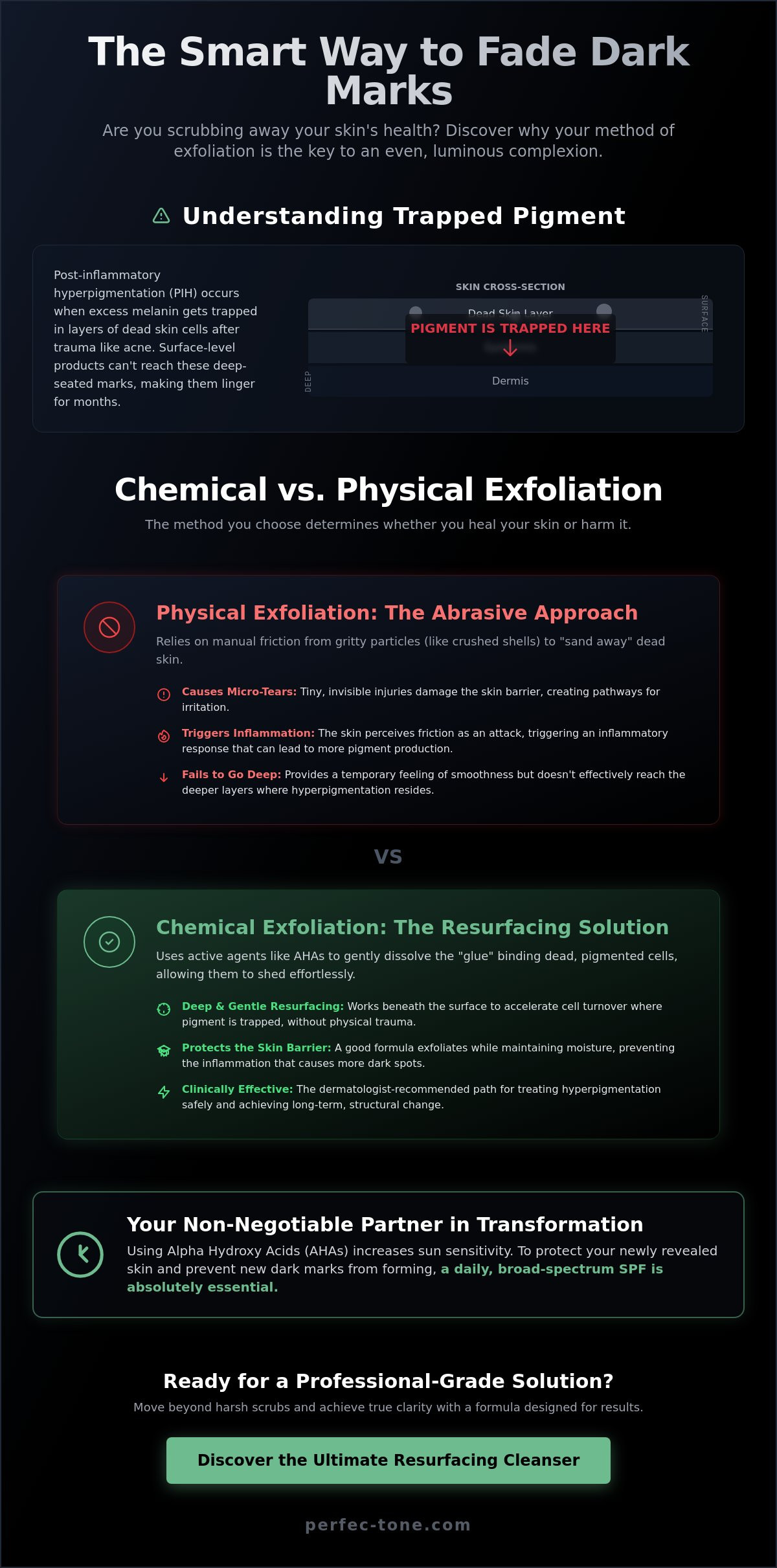
Why does a blemish that lasts three days leave a mark that lasts three months? This is the central frustration of post-inflammatory hyperpigmentation (PIH). When your skin experiences trauma, like an acne breakout or a minor abrasion, it overproduces melanin as a protective response. This excess pigment becomes "trapped" within the layers of dead skin cells that accumulate on the surface. To truly address this, you must understand the science of hyperpigmentation. It isn't just a surface stain; it's a biological backlog of pigmented cells that refuse to shed naturally. Without intervention, these marks remain visible for far longer than necessary.
Your skin's natural engine for clarity is cell turnover. This is the biological cycle where new, healthy cells rise to the surface to replace old, damaged ones. When this process slows due to age or environmental stress, dark marks become stagnant and "baked in." Many commercial products offer a temporary "brightening" effect by using light-reflecting particles or mild surface acids. However, true clarifying requires a structural shift. You need to signal the skin to accelerate its renewal process. This is why finding the best exfoliating cleanser for dark marks is critical. It moves beyond a quick glow to perform deep, structural resurfacing that physically removes the cells holding onto that stubborn pigment.
Do you find yourself using harsh acne scrubs that leave your skin red but the spots unchanged? Most standard acne washes are formulated to kill bacteria. While effective for active breakouts, they often ignore the residual pigment left behind. Even worse, the high concentrations of benzoyl peroxide or harsh sulfates in these products can trigger more melanin production. Your skin perceives the irritation as a fresh attack. A targeted approach must address both the texture of the skin and the melanin activity beneath the surface. You need a formula that clears the path for new skin without causing more trauma.
A compromised skin barrier is a magnet for persistent discoloration. When your barrier is "stripped" or dehydrated, inflammation increases. This inflammation acts as a signal for your melanocytes to keep producing pigment. The goal of a professional-grade routine is effective exfoliation without the dry, tight feeling. The best exfoliating cleanser for dark marks will maintain your moisture levels while it works. It should leave your skin feeling supple and resilient, not fragile. By protecting the barrier, you ensure that your skin has the resources it needs to repair and even out its own tone naturally.
Are you still using gritty scrubs to "sand away" your spots? Friction is often the enemy of even-toned skin. Physical exfoliation relies on manual force to lift dead skin. While this provides an immediate smooth feeling, it often fails to reach the deeper layers where pigment resides. In contrast, chemical exfoliants use active biological agents to dissolve the microscopic "glue" that binds dead, pigmented cells together. This process allows those cells to shed effortlessly, revealing the clearer skin beneath without the need for aggressive rubbing.
For those seeking the best exfoliating cleanser for dark marks, the chemical approach is nearly always superior. Large-particle physical scrubs, such as those containing crushed shells or pits, create microscopic tears in the skin's surface. These tiny injuries trigger an inflammatory response. For melanin-rich skin, inflammation is a direct precursor to more hyperpigmentation. By choosing a chemical resurfacing agent, you bypass this trauma entirely. Dermatologist-recommended treatments frequently prioritize these non-abrasive methods to ensure long-term clarity without compromising the skin's structural integrity.
AHAs are water-soluble acids that work on the skin's surface to improve texture and tone. Glycolic acid is the most famous member of this family. Its small molecular size allows it to penetrate deeply and rapidly, making it incredibly effective for stubborn discoloration. If your skin is more reactive, lactic acid offers a hydrating alternative. It resurfaces while simultaneously pulling moisture into the skin. These acids specifically target the bonds between pigmented cells, forcing the "backlog" of dark marks to move through the cell turnover cycle faster. Because AHAs can increase sun sensitivity, always pair your daily resurfacing routine with a broad-spectrum SPF.
If your dark marks are the ghosts of past breakouts, BHAs are essential. Salicylic acid is oil-soluble, meaning it can dive deep into pores to clear the congestion that causes acne in the first place. By stopping the breakout, you stop the mark before it starts. For those with highly sensitive or "reactive" skin, PHAs (Polyhydroxy Acids) represent the new generation of gentle exfoliation. They have larger molecules that stay on the very surface, providing a polished finish without the risk of stinging. A sophisticated cleanser often combines these acids to provide a synergistic effect, addressing both active congestion and lingering pigment in one step.
Selecting the best exfoliating cleanser for dark marks requires a diagnostic eye. You aren't just looking for a soap; you're looking for a clinical tool designed to reprogram how your skin sheds. A professional-grade formula must prioritize ingredient purity, removing the fillers that often cause the very irritation we're trying to heal. One of the most critical, yet frequently ignored, factors is the product's pH level. For exfoliating acids to remain biologically active, the formula must be slightly acidic. If a cleanser is too alkaline, those expensive acids simply won't work. They'll sit on the surface without ever dissolving the bonds of your dark marks.
Concentration levels are also a delicate balance. You want a "sweet spot" where the product is strong enough to trigger resurfacing but gentle enough for regular use. When searching for the best exfoliating cleanser for dark marks, look for supporting actives like Aloe Vera or Vitamin E. These ingredients act as a safety net, soothing the skin as the acids do the heavy lifting. This synergy ensures you get the results of a professional treatment without the downtime or the "stripped" feeling common in lower-quality products.
Your journey to clarity can be derailed by the wrong additives. Harsh sulfates like SLS or SLES are immediate red flags. They strip away your protective lipid layer, leaving your skin defenseless against environmental triggers. You should also reject any product containing large, jagged particles like fruit pits or walnut shells. These create uneven exfoliation and micro-trauma, which we know leads to more pigment production in melanin-rich skin. Finally, avoid artificial fragrances. These are often complex chemical cocktails that can trigger inflammatory responses deep within the dermis, making your dark marks more persistent.
The gap between high-end and mass-market products usually comes down to the "active load." While drugstore brands might include Glycolic Acid, it's often at such a low percentage that it barely affects cell turnover. Professional formulations are designed with higher stability and concentration to ensure consistent results. When you're comparing professional and at-home treatments, always read the label from the top. The active acid should be listed near the beginning of the ingredients. This ensures you're paying for a functional solution, not just a label claim.
Finding the best exfoliating cleanser for dark marks is only half the battle; how you apply it determines your success. Rushing into a high-active routine is a common pitfall that leads to unnecessary irritation. We recommend the "Slow and Steady" rule. Start by using your resurfacing cleanser just two or three evenings a week. This allows your skin to build a tolerance to the active acids without triggering a defensive, inflammatory response. As your skin adapts and feels resilient, you can gradually increase frequency to every other night, and eventually, every night.
Timing and technique are equally vital. While you can exfoliate in the morning, the evening is the gold standard for repair. During sleep, your skin's natural regenerative processes are at their peak, making it the ideal time for deep-seated pigment correction. When you wash, don't just rinse and go. Practice the 60-second rule. Gently massage the cleanser into your skin for a full minute, paying extra attention to areas with visible discoloration. This contact time is essential for the chemical agents to dissolve the bonds between pigmented cells. Immediately after patting your skin dry, apply your post-wash essentials to lock in moisture and soothe the newly exposed surface.
If you aren't wearing sunscreen, you're essentially wasting your time and money. Exfoliated skin is fresh, healthy, and incredibly vulnerable to UV rays. Skipping SPF creates a "one step forward, two steps back" trap where the sun immediately darkens the very spots you're trying to fade. The use of Alpha Hydroxy Acids (AHAs) accelerates the removal of surface skin cells, which inherently increases your skin's photosensitivity and risk of UV damage. Without a daily broad-spectrum shield, the sun will trigger fresh melanin production, undoing your hard-earned progress in a single afternoon.
An exfoliating cleanser does more than just clean; it preps your skin to absorb more concentrated treatments. By removing the "dead cell backlog," your cleanser clears the path for products like our Clarifying Gel or Resurfacing Crème to penetrate deeper and work more effectively. However, you must avoid "acid overload." If you're using a potent exfoliating wash, be mindful of how many other active acids you're layering in the same session. Watch for signs of over-exfoliation, such as persistent stinging, a "waxy" or overly shiny appearance, or unusual redness. If these occur, pivot your routine by stripping back to a basic moisturizer for a few days until your barrier recovers. Shop our targeted resurfacing collection to find the perfect balance for your unique skin needs.
Why settle for mass-market promises when you can rely on four decades of specialized expertise? Perfec-Tone isn't just another skincare brand; it's a legacy institution that has spent 40 years refining the science of clear skin for melanin-rich complexions. We understand that your skin requires a delicate balance of strength and support. Our clinical formulation was developed to deliver the results of a professional resurfacing treatment without the need for invasive procedures. It's a results-oriented solution for those who've been underserved by the broader industry for far too long.
The Perfec-Tone Exfoliating Cleanser stands out as the best exfoliating cleanser for dark marks because it respects the biological complexity of your skin. Many cleansers are either too weak to effect change or so aggressive they damage the moisture barrier. Our formula is meticulously pH-optimized. This ensures that the active resurfacing agents can dissolve pigmented bonds effectively while the nutrient-rich base keeps your skin supple. It transitions your complexion from dull and congested to luminous and even, providing the visible transformation you've been searching for.
Our "Intelligent Resurfacing" philosophy, pioneered by our founder Lila Pinder, is what truly sets us apart. We don't believe in forcing the skin into submission. Instead, our formula works in harmony with your skin's natural healing cycle. By gently accelerating cell turnover, we help your body shed dark marks at an optimal pace. This heritage of community-focused care means every bottle carries the weight of thousands of successful transformations. We're proud of our roots and our relentless focus on delivering tangible, life-changing outcomes for our global community.
While our cleanser is a powerhouse on its own, it performs best as part of a curated system. Use it to prep your skin, then follow with our Clarifying Gel for targeted spot correction. This combination ensures that you're addressing discoloration from multiple angles. Consistency is the bridge between your current frustrations and the clear skin you deserve. By staying committed to a professional-grade regimen, you're investing in the long-term health and clarity of your complexion. Don't wait for another month to pass with stagnant marks. Experience the transformation with our Exfoliating Cleanser and reclaim your confidence today.
Achieving a clear, even complexion isn't about aggressive scrubbing; it's about intelligent resurfacing. By now, you understand that chemical exfoliation is the superior method for dissolving the pigmented bonds that keep dark marks stagnant. You've also learned that maintaining a healthy skin barrier and prioritizing sun protection are non-negotiable steps in your journey toward clarity. Finding the best exfoliating cleanser for dark marks requires a formula that balances clinical strength with nourishing support, ensuring your skin remains resilient throughout its transformation.
With 40+ years of skincare expertise, Perfec-Tone provides dermatologist-grade results at home through products specifically formulated for melanin-rich skin. You don't have to settle for surface-level promises or wasted investments. It's time to follow a professional-grade routine that honors your skin's unique needs and delivers the life-changing outcomes you deserve. Are you ready to see the luminous results of a truly specialized regimen?
Shop the Perfec-Tone Exfoliating Cleanser for Clear, Radiant Skin
Your path to radiant skin is clear, and we're here to guide you every step of the way. Take the first step today and embrace the confidence that comes with a perfectly even tone.
Yes, a high-quality exfoliating cleanser can effectively fade deep discoloration by accelerating the rate of cell turnover. While surface-level brightening products only mask the issue, a resurfacing formula dissolves the microscopic bonds holding pigmented cells in place. This process allows your skin to shed old, damaged layers and reveal the clearer, more even-toned tissue beneath. For the most stubborn marks, consistency is the key to structural change.
You should begin by using a resurfacing wash two to three times per week to allow your skin to adapt. Melanin-rich skin is highly reactive to over-exfoliation, which can trigger defensive pigment production if introduced too quickly. Once your skin feels resilient and shows no signs of irritation, you can gradually increase usage to every evening. Always monitor your skin's response and scale back if you notice unusual sensitivity or dryness.
Exfoliation itself won't darken your spots, but improper technique or skipping sun protection certainly can. When you remove dead surface cells, the fresh skin underneath is more vulnerable to UV damage. Without a daily SPF, the sun will trigger fresh melanin production, making existing marks appear more prominent. Additionally, using the best exfoliating cleanser for dark marks too aggressively can cause inflammation, which signals the skin to produce more pigment as a defense mechanism.
Glycolic acid is widely considered the gold standard for resurfacing post-acne marks due to its small molecular size and deep penetration. It works efficiently to break down the "trapped" pigment left behind by old blemishes. If you're still dealing with active congestion, a formula that includes Salicylic acid is beneficial. This combination ensures you're clearing current blockages while simultaneously fading the ghosts of past breakouts for a truly clear complexion.
Chemical cleansers are the superior choice for treating hyperpigmentation because they provide a uniform, non-abrasive resurfacing effect. Physical scrubs often contain jagged particles that create microscopic tears in the skin's surface. These tiny injuries trigger inflammation, which is a primary cause of post-inflammatory hyperpigmentation (PIH). By choosing a chemical formula, you achieve a deeper, more consistent exfoliation without the risk of creating new marks through mechanical trauma.
Sensitive skin types can safely use exfoliating cleansers by choosing formulas with larger molecular structures like Polyhydroxy Acids (PHAs) or Lactic Acid. These ingredients provide a gentle polish on the surface without penetrating too deeply or causing a stinging sensation. It's essential to prioritize a pH-balanced formula that includes soothing agents like Aloe Vera. Start slowly, perhaps once a week, to ensure your moisture barrier remains intact while you work toward clarity.
You can typically expect to see visible improvement in skin texture and tone within four to six weeks of consistent use. This timeframe aligns with your skin's natural 28-day cell turnover cycle, allowing enough time for new, unpigmented cells to reach the surface. While some users report an immediate "glow" due to the removal of surface debris, the structural fading of deep-seated dark marks requires a sustained, professional-grade routine over several months.
Yes, applying a high-quality moisturizer after cleansing is a non-negotiable step to protect your skin barrier. Exfoliation removes the outer layer of dead cells, which can temporarily increase trans-epidermal water loss. Using a product like our Resurfacing Crème or Refining Crème immediately after washing seals in essential moisture and provides the nutrients your skin needs to repair itself. This step ensures your skin remains supple and prevents the "stripped" feeling that can lead to irritation.
Featured Product

Why You'll Love It You want your dark marks gone, but your skin does not tolerate harsh treatments. The s...
Clear skin and even skin tone, built for melanin-rich skin, not adapted from generic formulas.
