


find your
Perfect
Product
Did you know that over 65% of African Americans experience the persistent frustration of dark spots and uneven tone? For many, the journey of treating hyperpigmentation on black skin feels like a cycle of broken promises and "rebound" darkening caused by aggressive, ill-suited treatments. You've likely felt the exclusion of mainstream skincare or the valid fear that certain products might bleach or thin your skin. It's exhausting to search for a solution that truly understands the unique reactivity of your melanocytes.
We're here to validate those concerns and offer a path forward rooted in clinical expertise. You can achieve a clear, luminous complexion through the specialized science of melanin-informed resurfacing rather than dangerous bleaching. This professional guide will show you how to safely fade stubborn spots using high-performance topical solutions designed specifically for deeper skin tones. We'll examine how a regimen of exfoliating cleansers and refining crèmes can deliver visible results from your own home, giving you the confidence of a safe, expert-led routine that finally delivers the clarity you deserve.
Why does your skin seem to remember every minor injury? For those with deeper skin tones, the answer lies in the sophisticated biology of the melanocyte. Melanin is a powerful natural protector, shielding the skin from UV damage and premature aging, but it's also remarkably sensitive. In Black skin, these pigment-producing cells are in a constant state of high alert. While this provides a youthful resilience, it also means the skin reacts to any form of inflammation by flooding the area with excess pigment.
This biological reaction leads to Post-inflammatory hyperpigmentation, or PIH. It's the most common dermatological concern for individuals of African descent, yet many mainstream products ignore the specific needs of this skin type. Standard "one-size-fits-all" brighteners often fail because they don't account for this heightened reactivity. They either lack the specialized delivery systems to penetrate the denser epidermal layers of melanin-rich skin or, more dangerously, they contain harsh irritants that trigger even more darkening. Effectively treating hyperpigmentation on black skin requires a "wise mentor" approach: one that respects the skin's natural barrier while gently guiding it toward a state of radiant clarity.
Your skin doesn't need a major injury to trigger a dark spot. Heat, friction from tight clothing, and the bacteria within a single blemish are enough to send your melanocytes into an overproductive overdrive. Many people mistakenly turn to aggressive scrubbing or "gritty" physical exfoliants to "wash away" the spots, but this only compounds the problem by creating micro-tears and further inflammation. The Melanin Paradox is the biological phenomenon where the skin's natural defense mechanism, intended to protect against environmental damage, becomes a source of persistent, visible marking at the slightest hint of irritation.
Are your spots on the surface or buried deep? Distinguishing between epidermal and dermal discoloration is essential for your success. Epidermal spots are typically brown or black and appear well-defined, while dermal pigment often has a grey or bluish tint and sits deeper in the tissue. For most people treating hyperpigmentation on black skin, the path to transformation lies in surface-level resurfacing. By safely accelerating cellular turnover, you encourage the skin to shed these pigmented cells and reveal the clearer, more even tissue beneath. This process must be methodical and intentional, ensuring you don't cause the very trauma that restarts the cycle of darkening.
Why does a single breakout leave a shadow that lasts for months? While we've established that your melanocytes are naturally on high alert, identifying the specific events that trigger them is the first step toward a successful recovery. For many, these dark marks aren't just aesthetic concerns; they're reminders of past skin trauma. Understanding these triggers allows you to move from reactive hiding to proactive healing.
Acne is the primary offender. When a blemish forms, it triggers an inflammatory response that signals your melanocytes to produce excess melanin as a defense mechanism. This is the biological birth of a dark spot. In deeper skin tones, the resulting mark can range from deep brown to nearly black, often outlasting the original blemish by several months. Early intervention with a targeted spot treatment for discoloration is critical during this phase. It's also vital to distinguish between a temporary mark and a permanent scar. A mark is a change in pigment that can be faded with the right regimen; a scar involves a change in the skin's texture, such as pitting or raised tissue, which requires a different professional approach.
Hormonal shifts present another complex challenge, specifically in the form of Melasma. Often referred to as the "pregnancy mask," Melasma appears as symmetrical, patchy discoloration on the cheeks, forehead, or upper lip. In Black skin, these patches can be particularly stubborn because they're driven by internal triggers rather than external injury. Aggressive treatments often backfire here, as the heat from certain procedures can actually deepen the pigmentation. Success in treating hyperpigmentation on black skin when melasma is involved requires patience and specialized, non-irritating formulas that calm the skin rather than attacking it.
External irritants are a frequently overlooked trigger. Many "miracle" products found online contain high concentrations of acids or unverified ingredients that cause subtle chemical burns. These burns create new inflammation, effectively restarting the hyperpigmentation cycle. If a product causes excessive stinging, redness, or peeling, it's likely doing more harm than good. You deserve a routine that focuses on restoring your skin's natural balance without causing further trauma.
We must address the most dangerous misconception in skincare: the idea that Black skin doesn't need sunscreen. This myth is a significant barrier to treating hyperpigmentation on black skin effectively. While melanin provides a natural SPF of approximately 13, it's not enough to stop UV rays from "fixing" your dark spots. Sunlight acts as a catalyst; it darkens existing spots and makes them more resistant to treatment. Without daily broad-spectrum protection, your fading efforts are essentially neutralized the moment you step outside. Consistent sun protection is the absolute foundation required to fade dark spots in darker skin tones and prevent new ones from forming.
Are you tired of being told that your only option is a harsh bleaching agent? For decades, hydroquinone was marketed as the gold standard for discoloration. However, we now know it carries significant risks for deeper skin tones, including the potential for permanent, bluish-black discoloration known as ochronosis. In fact, since the FDA restricted over-the-counter sales of hydroquinone, the industry has shifted toward safer, more sophisticated alternatives. Treating hyperpigmentation on black skin effectively isn't about stripping away your natural color; it's about regulating the biological process that creates excess pigment.
The most effective approach involves using tyrosinase inhibitors. These specialized ingredients work by slowing down the enzyme responsible for melanin production at its source. By calming the "factory" rather than just bleaching the "product," you achieve a more sustainable and natural-looking clarity. When combined with dermatologist-recommended treatments for hyperpigmentation, these agents provide a professional-grade solution that respects your skin's integrity. To maintain a healthy, vibrant glow during this process, high levels of hydration are essential to support the skin barrier as it undergoes transformation.
Why do physical scrubs often fail? For those treating hyperpigmentation on black skin, gritty, abrasive scrubs are often too traumatic, leading to the very inflammation that triggers new dark spots. A more precise method is using a best exfoliating cleanser for dark marks that utilizes chemical exfoliants like glycolic or salicylic acids. These Alpha and Beta Hydroxy Acids (AHAs and BHAs) gently dissolve the "glue" holding pigmented dead cells to the surface, lifting them away without the need for aggressive friction. This clinical approach ensures that your correction is both deep and non-disruptive.
While many people believe that in-office lasers are the only way to see dramatic change, these procedures can cost between $400 and $1,250 per session and carry a high risk of post-inflammatory scarring for melanin-rich skin. A high-performance resurfacing creme for clear skin offers a safer, more controlled alternative. By combining refining agents that smooth texture and even out tone simultaneously, these topical solutions provide a consistent path to clarity. High-quality resurfacing crèmes deliver professional-level results at home, effectively bypassing the need for expensive and potentially invasive laser treatments.
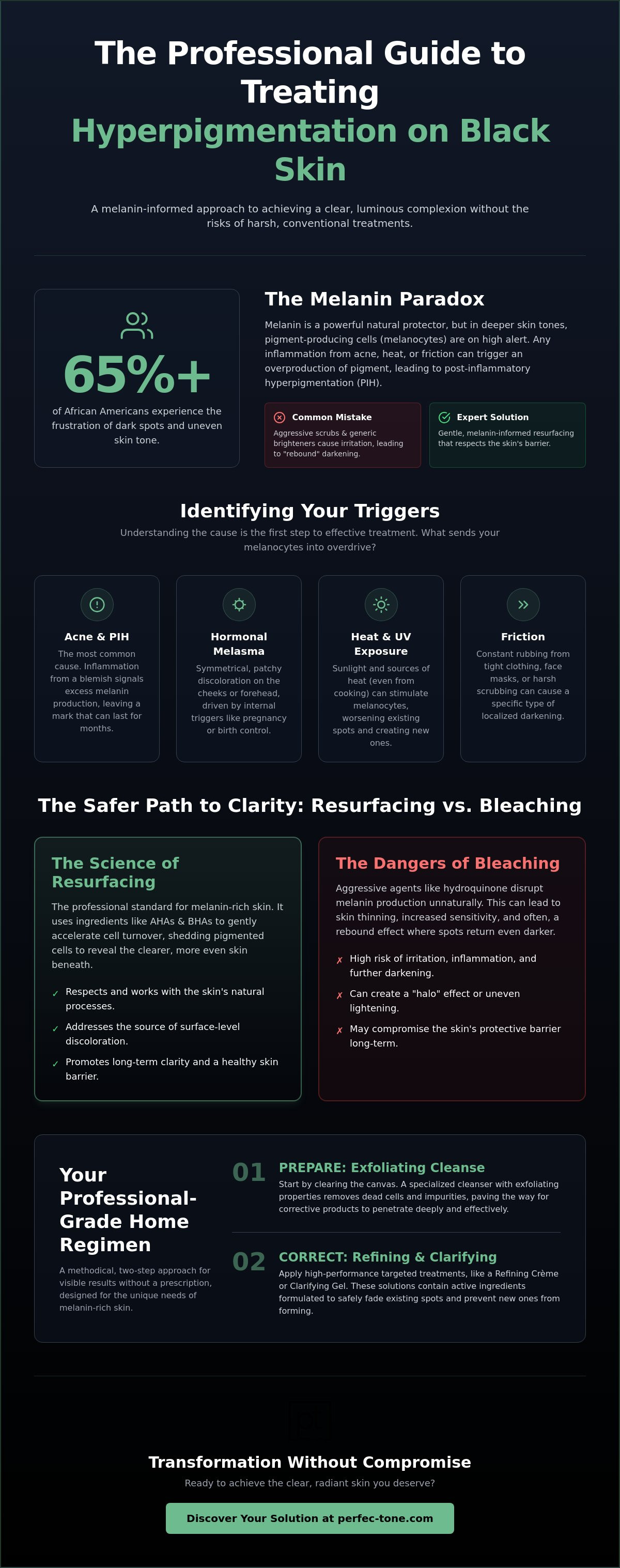
Are you ready to move from guessing to a structured, clinical approach? While generic advice often suggests a simple "cleanse and treat" cycle, treating hyperpigmentation on black skin requires an intentional sequence to ensure actives penetrate without causing inflammation. A professional-grade regimen is built on four distinct pillars: preparation, correction, resurfacing, and protection. By following this methodical order, you create a receptive environment for healing while respecting your skin's delicate balance.
The journey to clarity begins with these essential steps:
A common concern when starting a new routine is the fear of "purging" or irritation. To avoid this, introduce one new active at a time. If you experience mild tingling, it's often a sign that the ingredients are working; however, persistent stinging or redness is a signal to slow down. By pacing your introduction, you allow your skin barrier to adapt without triggering the inflammatory response that leads to more spots. You can build your customized clarity routine today to ensure you're using the right concentrations for your specific needs.
How do you target the most stubborn shadows without affecting your natural skin tone? This phase involves introducing a clarifying gel for hyperpigmentation to manage active discoloration. For the most uniform results, apply a thin layer to the entire face rather than just spot treating. This prevents the "halo" effect where the dark spot fades but the surrounding skin remains uneven. Start by using the gel every other evening, gradually increasing frequency as your comfort level grows.
Why is your evening routine the most powerful tool in your arsenal? While you sleep, your skin's permeability increases, making it the ideal window for a refining creme for uneven skin tone. Layering this over your clarifying gel maximizes absorption and accelerates the shedding of pigmented cells. During the first 4 weeks, monitor your progress closely. You should begin to see a visible refinement in skin texture and a gradual lifting of the deepest shadows, signaling that your professional-grade regimen is successfully treating hyperpigmentation on black skin.
You've spent enough time experimenting with products that weren't built for your specific needs. For decades, the mainstream skincare industry has treated deeper skin tones as an afterthought, leading to the "rebound" darkening and skin thinning we've discussed. The Perfec-Tone Method represents a definitive shift in this narrative. We've spent decades refining a specialized approach that focuses exclusively on the unique biological requirements of melanin-rich skin. This isn't just about selling a product; it's about providing the clinical authority and community-focused support you've been missing in your journey toward clarity.
Our philosophy centers on biological resurfacing rather than harmful bleaching. While many turn to the prescription pharmacy for aggressive, high-risk solutions, we believe in achieving professional results through smarter formulation. The Clarifying Gel difference lies in its ability to target clusters of pigment without compromising the health of your skin barrier. By choosing a path that respects your biology, you avoid the risks of ochronosis and chronic irritation often associated with unmonitored hydroquinone use. Transitioning from a basic routine to a professional-grade system is a declaration that you're ready for a permanent solution to the cycle of dark spots.
Why do so many products fail to deliver visible change on deeper complexions? Melanin-rich skin often has a thicker epidermal layer, which acts as a barrier to lower-quality actives. Our formulas use concentrated, high-performance ingredients designed to penetrate these layers effectively without causing the trauma that restarts the inflammatory cycle. We don't just aim for "lightness," which is a vague and often dangerous goal. Instead, we focus on Clarity. Clarity is the state where your natural tone is even, your texture is smooth, and your skin radiates health from within. The Perfec-Tone Guarantee is our commitment to this outcome, offering a results-oriented journey that finally validates your skincare frustrations. Treating hyperpigmentation on black skin shouldn't feel like a gamble; it should feel like a controlled, expert-led evolution.
It's time to move beyond the cycle of hope and disappointment. Treating hyperpigmentation on black skin is a precise science, and with a clinical strategy, your skin is capable of incredible renewal. You don't need invasive, high-risk procedures to see a difference in your complexion. You need a methodical regimen that works with your skin's natural repair cycles to lift shadows and refine your overall appearance. We invite you to step into a new era of confidence where your skin finally reflects your inner vitality. Experience the Perfec-Tone transformation today and discover the radiant clarity you've been searching for.
Achieving a clear and even complexion isn't a matter of luck; it's a result of clinical precision and specialized care. You've learned that treating hyperpigmentation on black skin requires a deep respect for melanin biology, shifting the focus from aggressive bleaching to gentle, effective resurfacing. By identifying your specific triggers and following a methodical, professional-grade regimen, you can finally break the cycle of stubborn dark spots and rebound darkening.
Since 1980, Perfec-Tone has been a pioneering force in melanin expertise. We've spent decades refining professional-grade formulas that allow you to achieve transformative results from the comfort of your home. Our results-oriented approach validates your journey and provides the tools necessary for lasting health and visible change. It's time to stop settling for generic solutions that don't see you. You deserve a routine that understands your skin's unique strength and reactivity.
Shop the Perfec-Tone Collection for Radiant, Even Skin
Your path to radiant clarity is ready. With the right strategy and a trusted mentor by your side, your skin's most luminous chapter is just beginning.
Hyperpigmentation is rarely permanent, though it requires a methodical approach to resolve. In melanin-rich skin, pigment can reside at different depths within the tissue. While surface-level marks often fade within a few months of consistent care, deeper dermal pigment takes longer to lift. Success depends on a professional-grade routine that accelerates cellular turnover without causing the inflammation that restarts the darkening cycle.
You can no longer purchase hydroquinone over-the-counter in the United States due to FDA restrictions finalized in 2026. While it was once considered a standard, its potential for side effects like ochronosis, a permanent blue-black discoloration, makes it a high-risk choice for deeper skin tones. We advocate for safer, biological resurfacing agents that regulate pigment production at the source without the risk of thinning or damaging your skin's natural barrier.
Visible changes typically appear within 4 to 12 weeks of consistent treatment. Since the skin's natural renewal cycle takes approximately 28 days, you need at least one full cycle to observe the first signs of fading. Stubborn or long-standing marks may require several months of a structured regimen. Patience is vital when treating hyperpigmentation on black skin; rushing the process with aggressive products often leads to rebound darkening.
Preventing new spots requires a two-pronged strategy: daily sun protection and rapid inflammation control. UV rays act as a catalyst that "fixes" pigment in place, making existing marks darker and harder to treat. Additionally, since any irritation can trigger your melanocytes, you must manage acne or injuries immediately with gentle, non-stripping products to stop the inflammatory response before it turns into a lasting shadow.
Aggressive physical scrubs can certainly make hyperpigmentation worse by creating micro-tears and inflammation. However, chemical exfoliation with AHAs or BHAs is one of the most effective tools for achieving clarity. These acids gently dissolve the bonds of pigmented dead skin cells, lifting them away without the friction that triggers reactive melanocytes. The key is choosing a professional-grade exfoliating cleanser designed for the specific resilience of deeper skin tones.
Yes, sunscreen is a non-negotiable step for anyone treating hyperpigmentation on black skin. While your natural melanin provides some protection, it doesn't block the specific wavelengths that trigger excess pigment production. Sun exposure darkens existing spots and makes them more resistant to your corrective gels and crèmes. Use a broad-spectrum SPF daily to ensure your fading progress isn't reversed by environmental exposure.
Skin bleaching uses harsh chemicals to strip away your natural melanin, often damaging your skin's health and integrity. Brightening, or clarifying, is a biological process that focuses on evening out your complexion and restoring your natural radiance. It works by regulating overactive pigment cells and accelerating the removal of darkened surface cells. Brightening honors your natural tone while removing the shadows left behind by past skin trauma.
Many traditional acne treatments are formulated with high concentrations of drying alcohols or benzoyl peroxide that can cause chemical burns on deeper skin tones. This irritation triggers the inflammatory response, leaving you with a dark spot long after the blemish has healed. You need a balanced approach that manages breakouts while simultaneously calming the skin and supporting the barrier to prevent the cycle of acne-induced shadows.
Featured Product

Why You'll Love It You want your dark marks gone, but your skin does not tolerate harsh treatments. The s...
Clear skin and even skin tone, built for melanin-rich skin, not adapted from generic formulas.
