


find your
Perfect
Product
What if the secret to a flawless, naturally radiant complexion isn't found in a dermatologist's laser suite, but right at your own bathroom vanity? Many people believe that professional-grade skin clarity is only possible through expensive in-office procedures. The truth is that a structured, clinical-grade topical regimen can be just as transformative. If you've been searching for how to treat uneven skin tone at home, you've likely felt the frustration of hiding blotchy skin behind heavy foundation or watching persistent dark marks refuse to fade despite using every "brightening" product on the shelf.
We understand that feeling of being underserved by the beauty industry's vague promises. You deserve an empowering, results-oriented approach that delivers the clarity you've been denied. This guide reveals the clinical-grade protocols and specialized ingredients needed to restore a radiant, even complexion from the comfort of your home. You'll discover how to transition from a confusing shelf of half-used bottles to a simple but powerful daily routine. We will explain the biological science behind effective resurfacing and identify the specific clinical ingredients that turn a dull, uneven tone into a clear, glowing complexion that no longer needs makeup to look its best.
What does your skin see when you look in the mirror? If you see a map of old breakouts, blotchy patches, or a persistent dullness that won't lift, you aren't alone. Uneven skin tone is a complex interplay between pigment irregularity and texture disruption. It isn't just about color; it's about how light hits your skin. When your surface is rough or your pigment is scattered, your complexion loses its natural glow. Learning how to treat uneven skin tone at home requires moving past the frustration of masking these concerns with heavy makeup and instead addressing the biological root of the problem.
At the heart of this issue are melanocytes, the specialized cells responsible for producing melanin. When these cells are healthy, they distribute pigment evenly. However, they can become overactive due to external or internal stressors. For a deeper dive into these biological pathways, Understanding Hyperpigmentation provides a comprehensive look at how these cells function. Essentially, your skin is trying to protect itself, but the result is a persistent dark mark that lingers long after the initial trigger is gone. Three main culprits drive this overproduction: cumulative UV damage, localized inflammation from acne, and systemic hormonal shifts.
To address these internal stressors effectively, many individuals look toward holistic wellness solutions. High-quality, all-natural supplements from Fantastic Nutrition can help support your body’s health and fitness goals, providing the internal foundation necessary for resilient, glowing skin from the inside out.
Not all dark spots are created equal. Solar lentigines, or sunspots, are the result of years of UV exposure and typically appear as flat, brown circles. Post-inflammatory hyperpigmentation (PIH) follows a breakout or injury, leaving a shadow where the wound used to be. Then there is melasma, a stubborn, symmetrical discoloration often triggered by heat or hormonal changes. Even texture plays a role. Enlarged pores and fine lines create tiny shadows that contribute to an "uneven" look, making a uniform complexion feel out of reach without targeted intervention.
Melanin is a powerful protector, but for those with melanin-rich skin, it can be a double-edged sword. Deeper skin tones often have "trigger-happy" melanocytes that react aggressively to even minor irritation. This is why aggressive bleaching treatments often backfire, causing more inflammation and deeper staining. The goal isn't to strip the skin. Instead, you must implement gentle but effective clinical-grade resurfacing. This approach calms the pigment-producing cells while lifting away existing discoloration, providing a safe, reliable path to lasting clarity.
Why wait for a dermatologist appointment when the solution is already in your hands? Professional skin resurfacing is the gold standard for correcting discoloration, but it doesn't require a clinical office. Skin resurfacing is the process of shedding damaged, pigmented surface cells to reveal the fresh, uniform skin beneath. While many assume this requires intense laser therapy, the reality is that consistent, high-quality topical intervention is often more sustainable. When you learn how to treat uneven skin tone at home, you're essentially taking control of your skin's renewal cycle. By using pH-balanced clinical formulations, you can achieve professional results without the downtime or irritation associated with in-office procedures.
The efficacy of these methods is well-documented in the clinical management of facial hyperpigmentation, which emphasizes the role of topical agents as a primary line of defense. The secret lies in precision. Standard over-the-counter products often lack the concentration needed to penetrate effectively, while clinical-grade options are designed to reach the layers where pigment is formed. This isn't just about scrubbing the surface; it's about signaling your skin to regenerate faster. By increasing cellular turnover, you effectively "push" the pigment out of the skin, replacing it with healthy, evenly toned tissue.
Have you ever used a gritty scrub only to find your dark spots looked even darker the next day? Physical exfoliants often cause micro-tears. These tiny injuries trigger inflammation, which in turn leads to more pigment production. This is especially risky for melanin-rich skin. Instead, we advocate for chemical exfoliants that gently dissolve the "glue" holding dead cells together. A specialized lactic acid treatment is a prime example of this. It provides a sophisticated way to resurface the skin while maintaining essential hydration, making it a safer choice for those seeking a radiant glow without the risk of trauma.
There is a dangerous misconception that you must "bleach" the skin to fix discoloration. Harsh lightening agents can be effective in short bursts, but they often damage the skin barrier or cause permanent white spots if used incorrectly. We focus on "brightening" and "clarifying" instead. These methods suppress excess pigment production without killing the melanocytes themselves. It's a more sustainable, health-focused approach. By supporting your skin's natural biology, you create a lasting transformation rather than a temporary fix. Discovering how to treat uneven skin tone at home is about choosing products that respect your skin's integrity. If you're ready to start your journey, exploring a professional resurfacing regimen is the first step toward reclaiming your confidence.
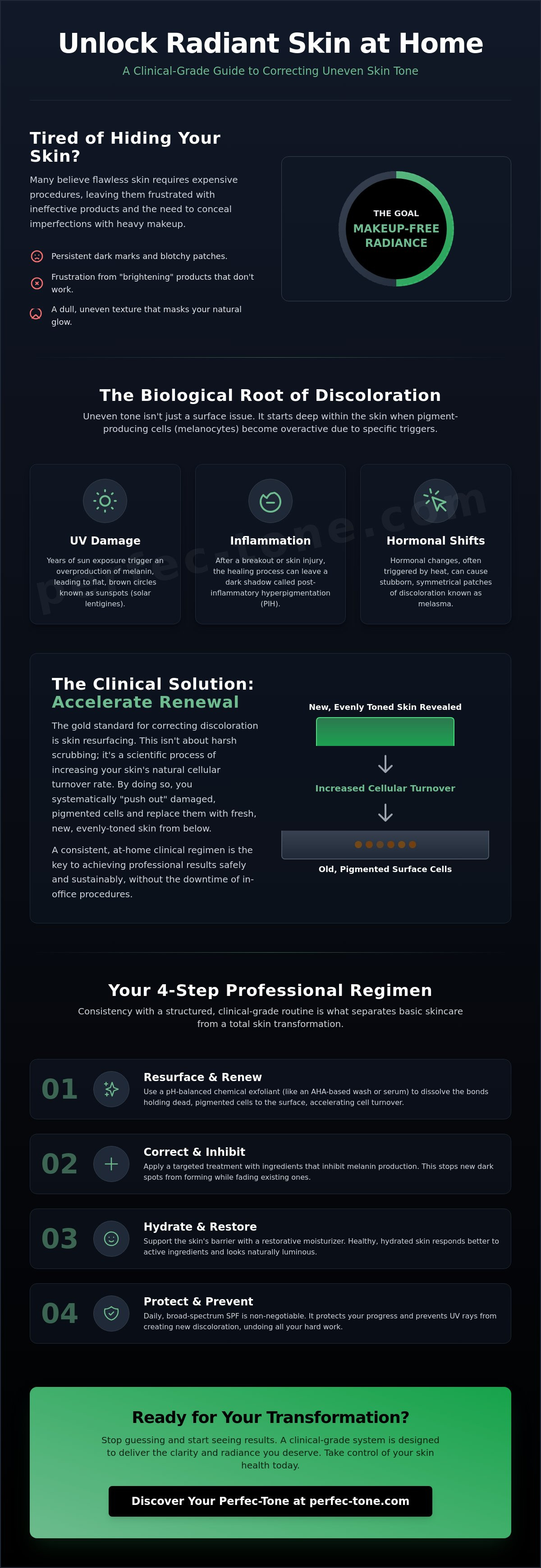
Is your current routine a collection of random products or a targeted clinical strategy? Achieving visible results requires a fundamental shift in mindset. You must prioritize consistency over intensity. While many people research the difference between at-home and in-office treatments, the most successful transformations happen through a disciplined daily protocol. A 4-step process is the absolute minimum for clinical-grade outcomes. This isn't about using the highest number of products. It's about using the right ones in the correct sequence to maximize absorption and biological impact. If you want to master how to treat uneven skin tone at home, you have to treat your skin like a professional would.
Preparation is the foundation of any successful treatment. Without proper cleansing, your expensive serums and creams simply sit on top of dead skin cells and environmental debris. By using "treatment layers," you can address multiple concerns simultaneously. You prep the skin to accept active ingredients, apply targeted inhibitors to stop pigment production, and then seal everything in to protect the barrier. This methodical approach ensures that every drop of product is working toward your goal of a clear, glowing complexion.
Your skin does its heaviest repair work while you sleep. This is the time to be bold with your corrective agents. After a deep cleanse to remove the day's pollutants, apply a clarifying gel for dark spots. This targeted layer works to actively fade existing marks and suppress new ones. Follow this with a resurfacing creme to accelerate cellular turnover throughout the night. Finally, seal your treatment with a nourishing moisturizer. This supports your skin barrier, ensuring you wake up with a complexion that is healthy, hydrated, and one step closer to perfect clarity. Learning how to treat uneven skin tone at home is a journey of patience, but with this professional structure, your results are inevitable.
Are you tired of guessing which ingredients actually move the needle for your skin? You don't need a medical degree to understand the biology of a clear complexion. You do, however, need to know which actives are worth your time. The most effective strategy for how to treat uneven skin tone at home relies on the "Holy Trinity" of correction: Exfoliants, Inhibitors, and Protectors. While many generic guides suggest that one single ingredient can fix everything, true transformation comes from the synergy between specialized acids and pigment-blocking agents. By choosing skin resurfacing without procedures, you can achieve the polished, high-clarity look of a professional peel without the associated trauma or downtime.
Professional-grade concentrations are the dividing line between products that work and those that simply sit on your shelf. When reading labels, look for formulations that prioritize active ingredients rather than fillers. Clinical-grade solutions are designed to penetrate the skin barrier effectively, reaching the deeper layers where melanocytes overproduce pigment. This isn't about using the harshest chemicals available. It's about using sophisticated, well-researched molecules that signal your skin to behave differently. When you combine the right exfoliants to lift away old damage with inhibitors that stop new spots from forming, you create a comprehensive environment for healing and health.
Why is Lactic Acid the preferred choice for those seeking a professional glow? Unlike harsher acids that can leave the skin parched and reactive, Lactic Acid is a natural humectant. It draws moisture into the skin while it dissolves the bonds between dead cells. This dual action is vital. Resurfacing crèmes that utilize this acid work to smooth texture and tone simultaneously, but the secret is in the buffering. A well-buffered clinical product delivers the active ingredient steadily. This prevents the inflammatory response that can actually trigger more hyperpigmentation in sensitive or melanin-rich skin. It's about achieving a smooth, glass-like finish while keeping the skin barrier resilient and hydrated.
Stubborn marks require a localized, high-stakes approach. A targeted spot treatment allows you to isolate persistent areas of discoloration without affecting the surrounding skin. Specialized clarifying gels are designed to break up these dense pigment clusters, while a Refining Crème provides the final polish. Refining is about more than just fading color; it's about perfecting the skin's surface so light reflects evenly across your face. When you combine these targeted brighteners with your daily resurfacing protocol, you finally bridge the gap between "skincare" and "skin transformation." Ready to take the next step? Explore our complete collection of corrective solutions to build your customized home regimen.
Why do some people achieve a flawless glow while others stay trapped in a cycle of trial and error? The difference isn't luck. It's the decision to move beyond generic "skincare" and embrace true skin transformation. When you master how to treat uneven skin tone at home, you aren't just applying products; you're implementing a sophisticated biological strategy. We believe that clear, radiant skin is an achievable reality for everyone, provided you have the right clinical tools. By using a curated, synergistic system, you ensure that every ingredient works in harmony rather than fighting for dominance on your skin's surface.
Mixing random brands often leads to ingredient conflicts and pH imbalances that stall your progress. A professional regimen is designed as a modular journey where each step builds upon the last. This intentionality is what separates a high-end consultation from a standard retail experience. You deserve a solution that validates your frustrations and delivers tangible, life-changing outcomes. It's time to stop hiding behind foundation and start trusting the science of specialized, professional-grade care.
Our brand carries the gravitas of a legacy institution. With over 40 years of specialized clinical expertise, we've spent decades refining the craft of skin restoration. We've always been bold innovators, challenging industry norms to better serve communities that have historically been underserved by the beauty industry. Our focus remains on high-potency, topical products that rival in-office results. This commitment to integrity and visible outcomes is what makes us a global leader. We don't make airy promises. We provide scientifically grounded solutions that respect the biological complexity of your skin.
Your path to clarity is unique. We encourage you to start with a foundational kit like the Clarifying Set to establish your baseline. This collection provides the essential building blocks for how to treat uneven skin tone at home with professional precision. As your skin adapts, you can adjust the frequency of your resurfacing treatments. If your skin feels resilient, you might increase the use of your Resurfacing Crème. If you need a gentler pace, you can scale back. You aren't doing this alone. You're joining a community of individuals who have reclaimed their confidence through expert guidance. Take the first step today and witness the high-stakes transformation your skin is capable of achieving.
You now possess the professional roadmap to move from masking your skin to truly transforming it. We've established that achieving a flawless complexion is a matter of biological precision, not luck. By implementing a structured 4-step regimen and utilizing high-potency ingredients, you can finally bypass the frustration of products that do nothing. Mastering how to treat uneven skin tone at home is no longer a mystery; it's an actionable protocol designed for those who refuse to settle for anything less than total clarity.
With over 40 years of clinical skincare expertise, we provide proprietary formulas designed for deep skin transformation. You deserve dermatologist-grade results without the office visit. It's time to trade your heavy foundation for a natural, healthy glow that reflects your true self. Shop the Perfec-Tone Clarifying Collection for Professional Results at Home and start your journey toward a more confident you. Your transformation is possible, and your best skin is just a regimen away. We're honored to be your trusted mentor on this path.
Visible results generally begin to appear within 4 to 6 weeks of starting a clinical regimen. This timeline aligns with your skin's natural 28-day regeneration cycle. For deep-seated hyperpigmentation, significant transformation usually requires 3 to 6 months of consistent application. Patience is essential because rushing the process with aggressive products can trigger inflammation and worsen dark marks. Stick to your daily protocol to see the cumulative benefits of professional-grade resurfacing.
You can certainly use a resurfacing crème with sensitive skin if you follow a "low and slow" approach. Begin by applying the product only two or three evenings a week to build tolerance. Our buffered clinical formulas are specifically designed to deliver active ingredients without the harshness often found in traditional treatments. Always monitor your skin for redness and seal your treatment with a nourishing moisturizer to protect your delicate skin barrier.
Lactic acid is widely considered the best ingredient for how to treat uneven skin tone at home when dealing with melanin-rich skin. It provides gentle exfoliation while maintaining essential hydration, which is vital for preventing the inflammatory response that triggers new dark spots. When paired with a clarifying gel that contains specialized pigment inhibitors, you can safely fade existing marks without the risk of over-lightening the healthy surrounding skin.
It is entirely possible to achieve clear skin without expensive in-office chemical peels. While a single professional peel is intense, a daily clinical-grade regimen provides a steady, controlled resurfacing effect that is often more sustainable for your skin barrier. By using a synergistic system of cleansers and corrective crèmes, you can gradually lift discoloration and refine your texture. This consistent approach delivers professional-grade clarity from the comfort of your home.
Wearing sunscreen indoors is a non-negotiable step when you're actively treating hyperpigmentation. UVA rays penetrate through standard glass windows, and blue light from digital screens can also stimulate melanocytes to produce excess pigment. If you're learning how to treat uneven skin tone at home, you must protect your progress at all times. Applying a broad-spectrum SPF every morning ensures that your corrective treatments aren't being undone by daily light exposure.
A resurfacing crème primarily focuses on accelerating cellular turnover to shed damaged, pigmented cells from the surface. In contrast, a refining crème acts as the final "polishing" step to smooth the skin's surface and minimize the appearance of pores. While resurfacing does the heavy lifting of fading dark marks, refining ensures your complexion has a glass-like, radiant finish. Using both in a modular system provides a comprehensive approach to skin transformation.
You can absolutely treat active breakouts and uneven tone simultaneously. In fact, many clinical resurfacing ingredients are designed to clear pores while they fade discoloration. This dual-action approach is highly effective because it addresses the inflammation that causes post-inflammatory hyperpigmentation (PIH). By calming current acne, you prevent the formation of future dark marks, creating a clearer path to a complexion that doesn't require heavy foundation to hide.
Most people should use an exfoliating cleanser once or twice daily to maintain a clear canvas for their treatment layers. If you have very resilient skin, twice-daily use helps keep cellular turnover at its peak. However, if you're just starting a professional protocol, you might begin with once-a-day use in the evening. This ensures you're removing pollutants and dead cells without over-stripping your natural oils, allowing your corrective crèmes to penetrate more effectively.
Featured Product

Why You'll Love It You want your dark marks gone, but your skin does not tolerate harsh treatments. The s...
Clear skin and even skin tone, not adapted from generic formulas — built specifically for dark spots, hyperpigmentation, and acne.
