


find your
Perfect
Product
Why does that stubborn dark spot on your leg refuse to budge, even though a similar treatment cleared your face weeks ago? You’ve likely tried every "brightening" lotion on the shelf, only to find yourself still hiding under long sleeves and swimwear. It’s exhausting to invest time and money into products that don't deliver; especially when you’re just looking for the confidence to show your skin. Many people find themselves asking why is body hyperpigmentation hard to treat compared to facial discoloration, and the answer lies deep within your skin's unique biology.
The truth is that your body's skin is structurally thicker and metabolically slower than your face. This means standard, one-size-fits-all solutions often fall short. Discover the clinical reasons why body discoloration persists and how to implement a professional-grade resurfacing strategy for lasting clarity. We will explore the science of slower cell turnover, the impact of constant friction, and the specific topical regimen required to finally achieve an even, radiant tone from head to toe.
Have you ever wondered why your favorite facial serum does absolutely nothing for the dark marks on your back or knees? It’s a common frustration. Most people assume that skin is skin, but clinical reality tells a different story. To understand The Biology of Stubbornness, we must look at how the body produces localized darkening. This process occurs when excess melanin is triggered by trauma, friction, or hormonal shifts. While the face is often the focus of skincare, it's actually the body that presents the greatest clinical challenge. This is precisely why is body hyperpigmentation hard to treat; your body skin isn't just a larger version of your face. It is a completely different biological landscape.
The most significant hurdle is the stratum corneum, the outermost layer of the epidermis. On your face, this layer is relatively thin and delicate, allowing active ingredients to pass through with ease. On your back, legs, and arms, however, this barrier is significantly thicker and more resilient. This toughness serves a purpose; it protects you from the environment. But it also acts as a wall. Standard brightening serums designed for the face lack the potency or the specialized delivery systems to penetrate this dense layer. Without high-performance formulations, your treatments simply sit on the surface, never reaching the melanocytes responsible for the discoloration. Professional-grade resurfacing requires a strategy that accounts for this dermal density. If you aren't using a specific Exfoliating Cleanser or a high-potency Resurfacing Crème designed for the body, you're just moisturizing the barrier rather than correcting the pigment.
Melanin density isn't uniform across your entire frame. Areas prone to constant movement and physical stress, such as elbows, knees, and underarms, are biologically programmed to be more protective. This protection often manifests as increased pigment production. When these areas experience friction or inflammation, the melanocytes become hyper-reactive. This is a survival mechanism, but it results in deep, persistent staining that is notoriously difficult to reverse. It's a major factor in why is body hyperpigmentation hard to treat for so many people. Body melanocytes are more reactive because they are conditioned to respond to the constant mechanical stress of a high-motion environment. Because these cells are often more concentrated in areas of friction, the resulting marks are darker and more resilient than those found on the face.
While sun exposure is often blamed for facial spots, body discoloration usually stems from a more aggressive source: inflammation. Post-Inflammatory Hyperpigmentation (PIH) is the primary driver of dark marks on the shoulders, back, and chest. It often follows a bout of body acne or folliculitis. But there is another, more subtle culprit that most people overlook. Friction, Inflammation, and the 'Hidden' Triggers of skin trauma create a constant cycle of pigment production. This mechanical stress is a fundamental reason why is body hyperpigmentation hard to treat; even while you treat the skin, your daily movements might be re-triggering the damage.
When your skin experiences chronic rubbing, it doesn't just get sore. It defends itself. The skin signals a "thicken and darken" response to protect the underlying tissue. This low-grade inflammatory state keeps melanocytes in a state of high alert. If you're wearing tight synthetic fabrics or dealing with skin-on-skin contact, you're essentially telling your body to keep producing melanin. Hormonal shifts can amplify this, making areas like the neck and underarms particularly sensitive to these triggers.
Have you noticed certain areas getting darker despite your best efforts? This is often a clinical condition known as acanthosis nigricans, which is frequently linked to insulin levels and exacerbated by friction. In these high-motion zones, tight clothing traps heat and moisture, leading to "trapped" inflammation. It’s a vicious cycle of irritation. Every time you scratch or rub the area, you push the pigment deeper into the dermal layers. This makes the discoloration more resilient to surface-level creams. To see real change, you must address the physical stress while using a targeted Clarifying Gel to calm the reactive melanocytes.
Why do breakouts on your back leave marks that last for months? Unlike the face, "backne" occurs in skin that is significantly thicker, as we discussed in the previous section. This means the inflammatory response happens deeper in the tissue. When a pore becomes infected, it often leads to secondary infections that cause permanent textural changes alongside the dark stain. Breaking this cycle requires more than just a spot treatment. You need the best exfoliating cleanser for dark marks to remove the surface barrier and clear the follicular debris before it turns into a long-term mark. Without this deep-cleansing step, the inflammatory cycle simply repeats, leaving you with a map of past breakouts that refuses to fade.
Have you ever felt like your body treatments have completely stalled? You might see a visible shift in your facial complexion within three weeks, yet the marks on your legs look exactly the same. This isn't necessarily a failure of your product; it's a matter of biological timing. While your face typically renews its skin cells every 28 to 30 days, the skin on your body operates on a much slower schedule, often taking 45 to 60 days to complete a full cycle. This metabolic lag is the primary reason many people abandon their regimens just as they are about to turn a corner. It's also a core factor in why is body hyperpigmentation hard to treat; you're essentially waiting twice as long to see the "new" skin reach the surface.
Slower turnover means that pigmented cells remain visible on the surface for a punishingly long time. Without active, clinical intervention, that "old" dark skin sits stubbornly on top of the "new" clear skin, effectively masking any progress happening underneath. These clinical management challenges require a shift in perspective. You aren't just waiting for a spot to fade; you're waiting for a physical layer of the body to shed and replace itself. If you don't account for this 60-day window, you'll likely give up on a regimen that is actually working deep within the dermis.
Think of your skin as a slow-moving conveyor belt. A melanocyte produces pigment in the basal layer, and that pigmented cell must then travel through multiple layers of the epidermis before it can be shed. On the extremities, this journey is further slowed by lower blood circulation compared to the highly vascularized skin of the face. Less blood flow means fewer nutrients and a slower rate of repair. Visible results on the body require a longer commitment than the face due to slower desquamation. To overcome this, you must keep the "conveyor belt" moving through consistent, high-potency stimulation.
Why isn't a simple shower scrub enough? While physical loofahs or beads might smooth the surface, they don't address the deep-seated pigment trapped in the thicker layers we discussed earlier. To truly break the turnover trap, you need a synergistic approach. Chemical resurfacing dissolves the "glue" holding dead, pigmented cells together, while mechanical action helps sweep them away. This dual-action strategy is essential for why is body hyperpigmentation hard to treat with standard soaps alone. By following the Ultimate Guide to Resurfacing Crème for Clear Skin, you can implement deep-level exfoliation that forces the skin to accelerate its natural shedding process. This doesn't just reveal clearer skin; it trains your body to heal at a more "facial" pace.
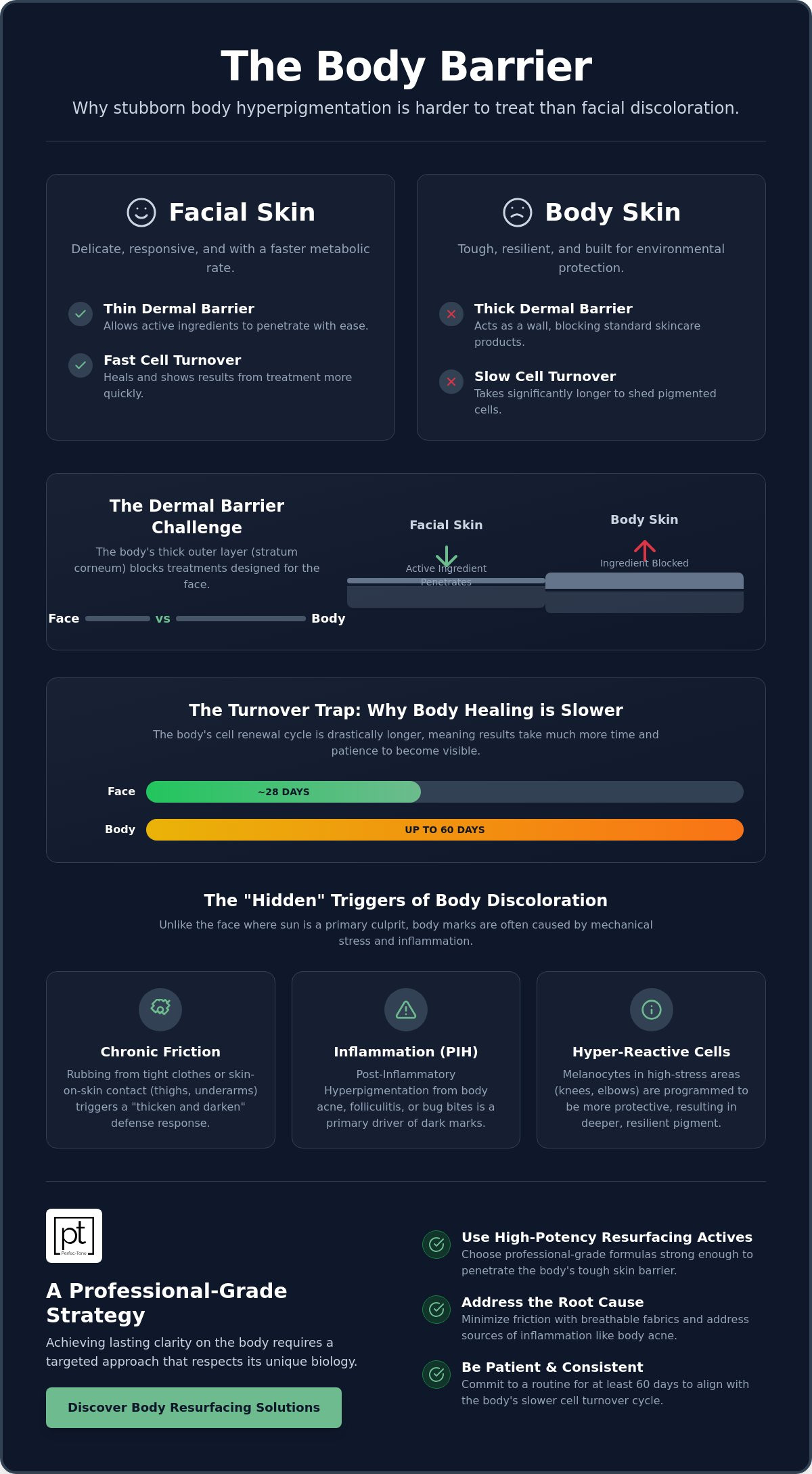
If you've been treating your body with leftover facial serums, it's time to pivot. As we've established, the structural density of your body skin creates a formidable barrier. Weak, diluted formulations simply can't penetrate deep enough to make a difference. This clinical reality is exactly why is body hyperpigmentation hard to treat with standard drugstore lotions. To see a visible transformation, you must transition to a high-potency regimen that respects the body’s unique physiology. You need a system designed to work through the "turnover trap" and reach the melanocytes where discoloration begins.
A professional-grade strategy follows a logical, four-step progression to ensure lasting clarity. First, you must implement deep cleansing and prep using an Exfoliating Cleanser to strip away the thickened stratum corneum. Second, you apply targeted correction to inhibit melanin production at the source. Third, you introduce resurfacing agents to force the skin to turn over at an accelerated rate. Finally, you protect the moisture barrier to prevent the very inflammation that triggers new spots. This isn't just about "lightening" the skin; it’s about total skin renewal. Just as Peotter's Auto Spa specializes in high-end surface preservation for luxury vehicles, your body requires a dedicated system to maintain its aesthetic health and clarity.
Concentrated pigment requires concentrated solutions. When you move into the correction phase, using a clarifying gel for dark spots is essential for blocking the enzymes that produce excess melanin. Because body skin is so thick, these "spot treatments" must contain higher active concentrations than those used on the face. Many people worry that high-potency products will thin the skin, but the opposite is true. Controlled resurfacing with a Resurfacing Crème actually strengthens the dermis over time by stimulating healthy cell production. You aren't damaging the skin; you're simply removing the damaged, stained layers to reveal the health underneath.
One of the most common mistakes is skipping sun protection on the body once the marks start to fade. UV rays are powerful enough to penetrate thin summer clothing, reaching your treated skin and re-darkening those hard-won spots. If you're investing in a professional regimen, you must protect that investment. Antioxidants also play a vital role here, as they neutralize the oxidative stress caused by environmental pollutants and heat. This protection ensures that the inflammation cycle we discussed in earlier sections stays closed. To begin your journey toward a truly even tone, explore our professional-grade body collection and give your skin the clinical attention it deserves.
Skincare should be a source of empowerment, not a cycle of endless frustration. Perfec-Tone was founded on a singular, disruptive principle: professional-grade results must be accessible to everyone at home. For too long, the industry has relied on generic formulas that fail to address the complexities of melanin-rich and stubborn skin. This lack of specialization is exactly why is body hyperpigmentation hard to treat for so many. We don't offer airy promises. We provide a disciplined, clinical framework designed to penetrate the thickest dermal barriers and deliver tangible, life-changing outcomes.
The "Perfec-Tone Way" is more than just a regimen; it is a partnership between clinical authority and a supportive, results-driven community. We understand the emotional weight of persistent dark marks from body acne or friction. By combining our specialized expertise with your commitment to a daily routine, we move you from a place of self-consciousness to a state of total confidence. You aren't just buying a product. You are investing in a proven system that has been refined over decades to handle the most resilient discoloration.
This journey toward total confidence often involves refining every aspect of your public image, which is why many also turn to Content Removal to ensure their online presence is as clear and professional as their newly restored skin.
To achieve a radiant, head-to-toe glow, you need tools that can handle the body's unique biology. Our Clarifying Gel serves as the anchor of our body treatments, specifically engineered to inhibit excess melanin production in high-stress areas like the underarms or inner thighs. When paired with our Resurfacing Crème, which acts as a powerful "liquid peel," you can finally bypass the body's tough outer layers. For those struggling with textural issues alongside discoloration, the Refining Creme for Uneven Skin Tone is essential. It smooths the skin's surface and ensures that your new, clear skin is as soft as it is radiant.
What does a clinical transformation look like? In the first 30 days, you'll notice a visible improvement in skin texture as the initial layers of dead cells begin to shed. By day 60, you'll see the pigment lifting as the body's natural turnover cycle finally reveals the clearer layers beneath. By day 90, deep-seated marks reach the surface and fade, resulting in lasting clarity. We encourage every client to take "before and after" photos to track this progression. Seeing the physical evidence of your skin's healing is the ultimate validation of your discipline. Are you ready to stop wondering why is body hyperpigmentation hard to treat and start seeing real change? Explore our full range of clarifying treatments and start your journey to radiant skin.
You now understand the deep-seated biological reasons why is body hyperpigmentation hard to treat compared to facial discoloration. From the density of the dermal barrier to the sluggish 60-day cell turnover cycle, your body requires a more rigorous and specialized approach. Stop settling for ineffective lotions that barely scratch the surface. It’s time to implement a regimen that matches the resilience of your skin and addresses the root causes of stubborn marks. You have the knowledge; now you need the clinical tools to act.
Perfec-Tone brings over 40 years of specialized expertise in melanin-rich skin directly to your home. Our results-driven approach provides clinical-grade formulations that empower you to achieve professional outcomes without the need for invasive procedures. We believe that everyone deserves a solution that validates their frustrations and delivers tangible, life-changing change. Are you ready to reveal the radiant skin you were always meant to have? Start your transformation with the Perfec-Tone Body Restoration Kit and embrace a new standard of clarity. Your journey to an even, confident glow from head to toe begins today.
Hyperpigmentation on the legs takes longer to fade because the skin there has a much slower cell turnover rate than your face. While facial cells renew every 30 days, leg skin can take up to 60 days to complete a cycle. Additionally, circulation is lower in the extremities, which slows down the rate of repair. You must be patient and consistent to see those pigmented layers finally shed.
Mechanical friction is a major, often hidden trigger for dark spots. When clothing or skin rubs together, it creates a state of low-grade inflammation. Your body responds by thickening and darkening the skin as a protective defense mechanism. This is common in areas like the inner thighs and underarms. Switching to loose, breathable fabrics is a simple way to help break this inflammatory cycle.
You can use facial products on your body, but you likely won't see the results you want. Body skin is significantly thicker than facial skin, meaning serums designed for the cheeks often can't penetrate deep enough to reach the melanocytes. This structural difference explains why is body hyperpigmentation hard to treat with standard facial regimens. You need high-potency, body-specific formulations to see real change.
You should expect to see significant results within 60 to 90 days of consistent treatment. Because the body's metabolic cycle is slower, the first 30 days are often spent just prepping the surface and clearing the barrier. By the second and third months, the deeper, clearer skin layers finally reach the surface. Consistency is the only way to overcome the body's natural healing lag.
Stubborn marks on the back require high-potency resurfacing agents that can penetrate the body's thickest skin. Look for a professional-grade Resurfacing Crème that forces rapid cellular turnover. Because the back is prone to "backne" and deep follicular inflammation, a combination of chemical exfoliation and targeted melanin inhibitors is necessary to lift deep-seated stains and smooth the skin's texture.
Most surface-level discoloration can be successfully treated at home with a professional-grade regimen. Our formulations provide a clinical alternative to expensive in-office procedures. However, if your dark spots are accompanied by pain, sudden changes in shape, or deep textural scarring, it's wise to consult a dermatologist. For standard PIH or friction marks, a disciplined home routine is often enough.
Dark spots can return if the original triggers, such as friction or UV exposure, are not addressed. Even after your skin clears, the melanocytes in those areas remain biologically reactive. This is another reason why is body hyperpigmentation hard to treat for the long term. Maintaining your results requires ongoing sun protection and a gentle maintenance routine to keep the skin calm and clear.
Prevention starts with stopping the inflammatory cycle before it triggers melanin production. Wear loose clothing to reduce friction and always apply SPF to exposed areas, even in the summer. Regular use of an Exfoliating Cleanser keeps pores clear and prevents the breakouts that lead to PIH. By protecting the skin barrier daily, you stop new marks from forming at the source.
Featured Product

Why You'll Love It You want your dark marks gone, but your skin does not tolerate harsh treatments. The s...
Clear skin and even skin tone, built for melanin-rich skin, not adapted from generic formulas.
